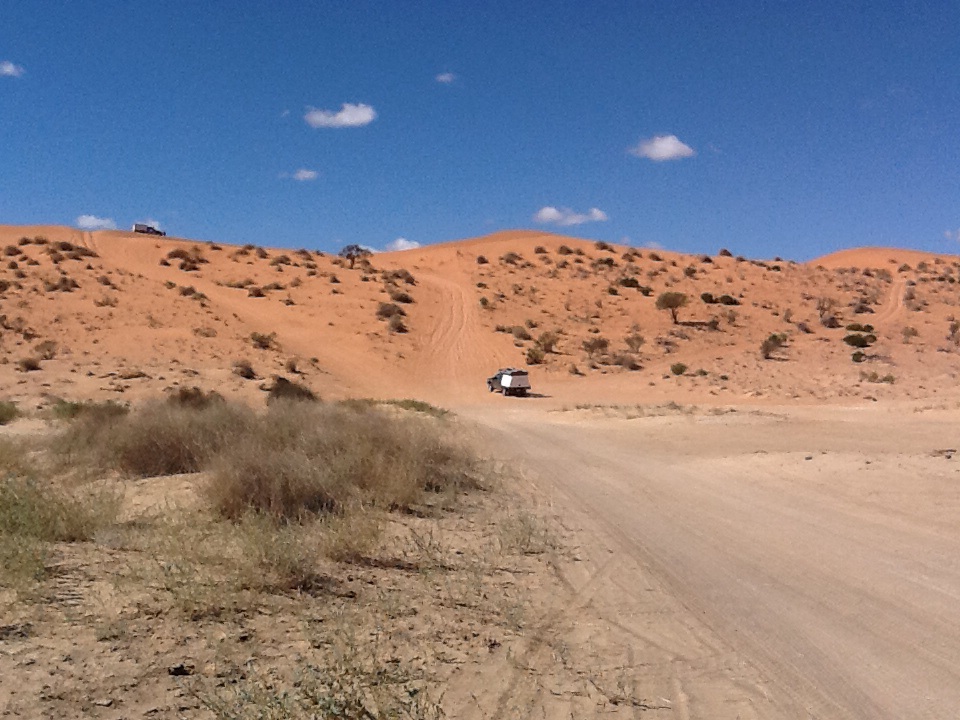
Party time

The Dixie Chicks vie with Sara Storer on the radio as we speed along the highway.  We laugh at the termite mounds along the road side that have been dressed with t shirts and baseball caps. Surreal sculptural shapes are used to comic effect.   Others are left untouched.   The high rise cities of the termites spread into the green belt around the road.   Huge skyscrapers in the centre of the cities shrink to modest mounds in the termite suburbs.

The vegetation along the roadside is changing as we near the Tropic of Capricorn.  Red holly grevilleas flourish alongside acacias and ghost gums.  We pass through Tennants Creek.  Telstra reception is back.  Emails are sent, mobile phone calls made.

Our roadside lunch stop hides beautiful pink, yellow and blue wildflowers and a wild calistemon.   Another secret botanist’s delight.

We stop briefly at Newcastle Waters.   Driving through the milky waters of the wetlands to admire the statue remembering the unsung heroes, the drovers, the pioneers of the cattle industry.  We recall Banjo Patterson’s verse: “As the stock are slowly stringing, Clancy rides behind them singing, for the Drovers life has pleasures that the townsfolk never know”.

We hurtle on down the highway.   Trees grow taller as wetlands branch out around us.   Huge road trains carrying four trailers thunder by.  We are nearing the top end, the north coast of Australia.

Tonight is party night at the caravan park at Daly Waters.   Huge meals of locally caught Barramundi or Northern Territory steak are served here.  Orders are for a fixed time, and names are called out from the kitchen when the meals are ready.  We wait in great anticipation and feel like winners when we hear Brett and Christine, Richard and Deborah, Olive and Malcolm, Max and Heather and finally Beryl and Howard shouted out to the packed restaurant.

Live music is provided by a one man band playing a guitar and singing rock and roll tunes against a backing tape.   No one could be more surprised than the singer when we get up to dance after the meal.  Max and Heather show off their dancing prowess in jive style.   Christine is a winner in Nutbush City Limits and The Timewarp.   We are joined by a table celebrating a birthday and demand an encore.  The surprised singer plays on for an extra half an hour as we all strut our stuff.

Party time at Daly Waters, we know how to enjoy ourselves!

Dark Spirits and Standing Stones

The speed limit on the highway north of Alice is 130 kmh. Road trains, caravans and campers share the road. We are all travellers, passing through at high speed, our minds on our destinations. The community of the road is estranged from the country that lies to either side. The two nations rarely meet. We speak different languages and eat different food. I feel uneasy, a foreigner in my own country.

And the heat, the heat! My head pounds with the oppressive heat of the glaring sun. My sense of unease grows. I feel the dark spirits of ancient murders around me.

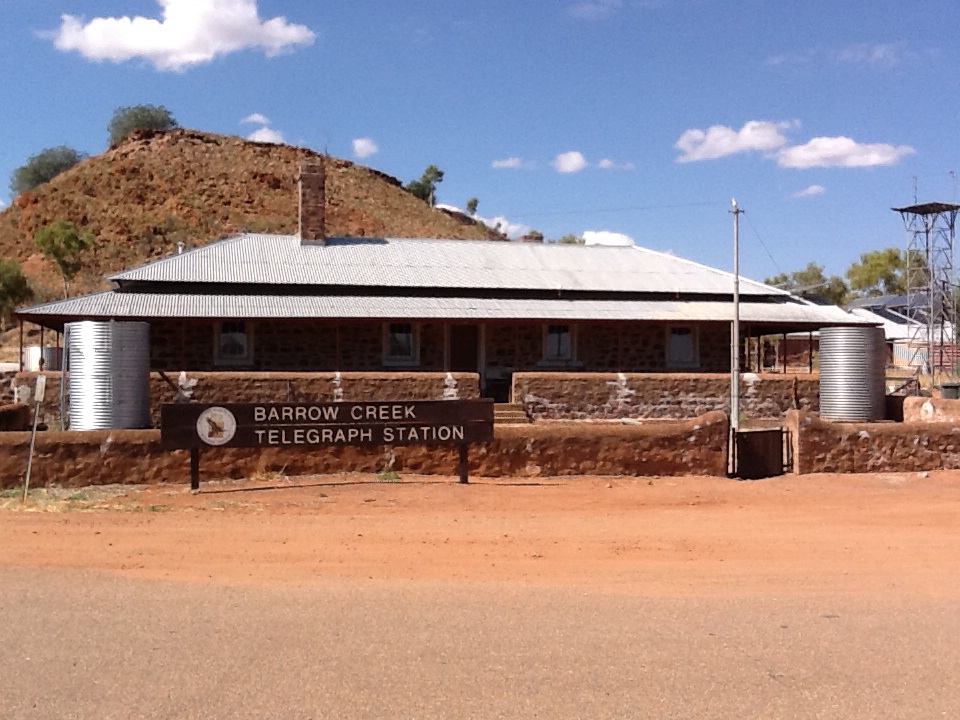
Telegraph Station at Barrow Creek

Telegraph Station at Barrow Creek

We stop at Barrow Creek where tensions between settlers and the local indigenous people have exploded over the years, with murderous consequences. In the late nineteenth century, two white settlers manning the telegraph station were killed by an aboriginal group. It is believed this was in response to fencing off a major waterhole. In reprisal, ninety men, women and children were slaughtered. Later, in 1928, a white dingo trapper was murdered. The local police carried out a bloody series of reprisals, resulting in the deaths of around 70 people. The Coniston Massacre, as this infamous event is known, was the last major massacre of aboriginal people in Australian history.

The dark spirits woken by these murders have not yet been put to rest. In 2001 Peter Falconio lost his life on the stretch of road just north of here. His body has never been found.

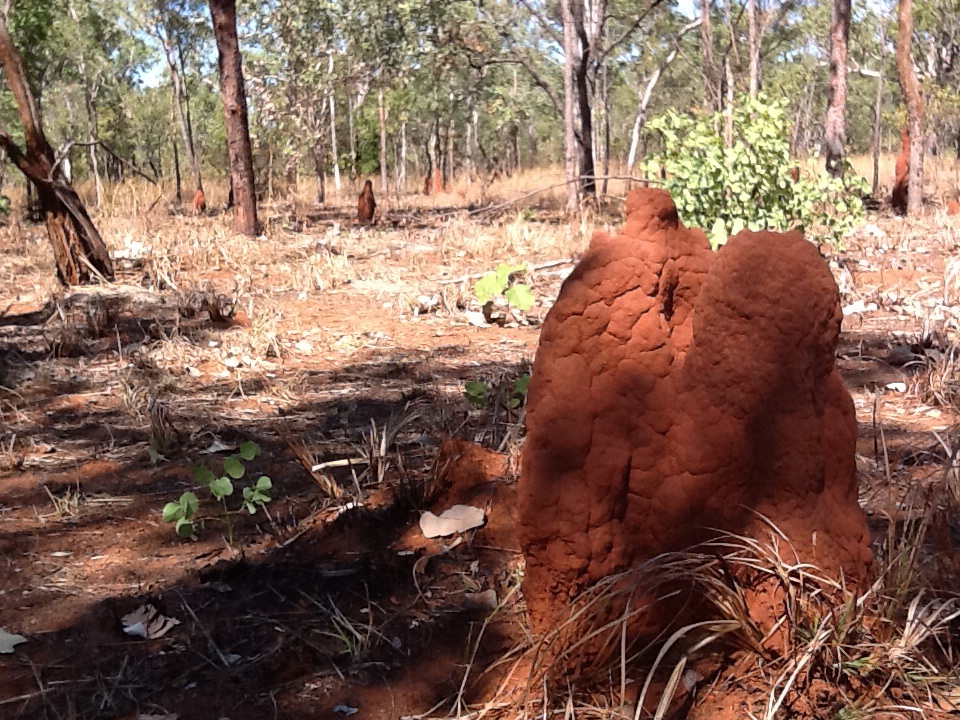
Termite mound

Termite mound

I gaze out of the window. The alien shapes of termite mounds dotted between the trees look like Neolithic standing stones, cathedrals to an ancient religion.

The heat intensifies. The air conditioning in the car is working hard to little effect. We pull into the ancient aboriginal dreaming site, known in four different aboriginal languages as Karlu Karlu and to white Australia as the Devil’s Marbles. My head throbs.

Devils Marbles

Devils Marbles

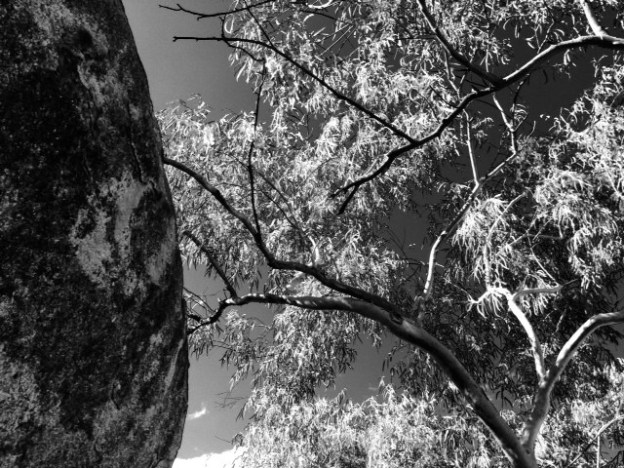
I sit, leaning against the massive granite boulders while the others walk around the site.   Perspiration wets my skin, despite the shade.   I sense the rocks as a living entity, pulsing with earthly power.  There is power, but no malice here.  The rocks were formed through millions of years of erosion.  They have lived through many generations of human experience.   Their powers are beyond the comprehension of the new settlers in this land.   We are too civilised to understand.   But not too civilised to feel.

The rocks glow in the afternoon sun as we get back into our vehicles and head for the highway.

My head begins to clear as we pull away, but still the heat is unbearable.  We take a detour off the highway and find a bush camp by a small waterhole.   The water is so inviting, we clamber in for an evening swim.  Trees frame the banks and birdsong vies with the chirp of crickets and cicadas.   The cooling water washes away the unease I had felt during the day.  The heat of the day fades.

We relax around the campfire, eating a delicious camp oven meal cooked by Brett and Christine and turn in early to enjoy the peace of this tranquil camping spot.


A Town Called Alice

We fly along as rutted red clay tracks become wide, easy driving unsealed roads. A squadron of budgies swoops past to check us out as we rattle across a cattle grid, the white trunks of ghost gums bright against the clear blue sky in the distance.

We are on our way to a town called Alice. Phones ring out as we reconnect to the outside world. The landscape morphs again, soft green alternating with ochre stone in stripes undulating along the mountain range beside us. Black headed grasses sway in our slipstream.

The roads begin to buck and roll with the mountain ranges, turning our pleasant drive into a fairground roller coaster. I gasp as the ute flies into the dips and over the crests.

The Stuart Highway, the main route from Adelaide through Alice to Darwin, is the first bitumen sealed road surface we have driven on in a week. Culture shock hits us as we turn right on to the road. The Royal Flying Doctor Service Centre passes on the left, a solar power station on the right. We are back in civilisation. It’s not a good feeling. Fences and signs grate on the nerves after the wide open spaces of the desert. We lose our freedom, but gain the benefits of supermarket shopping, hot showers and counter meals.  Is it worth the trade?

The entry to Alice from the South is through the Heavitree Gap.  This is a natural gap in the Macdonnell Ranges that allows river, road and rail to pass through.  The imposing rock faces tower above as we squeeze through the opening and into Alice Springs.

We take the opportunity to stock up on groceries, savour a real coffee and listen to the owner of an indigenous music shop give a sample of throaty didgereedoo music. The shop’s sales of music sticks soar as money changes hands.   Everyone enjoys time to do their own thing.   I visit an indigenous art gallery.  Richard cleans the car from top to bottom, vacuuming out every last speck of red desert dust.

The art gallery has a huge selection of work.  Indigenous artists are painting in the studio behind the shop and the owner gives me a tour of the back room full of huge works, intended for corporate foyers or board rooms.   The variety and quality is impressive.  I am tempted by a cross hatched painting of men fishing in a canoe and a superb dot painting representing the dunes of the Simpson Desert.   I will try to find time to return when we come back to Alice later on in the trip.

We overnight in the Heavitree Caravan Park, just outside the gap.   It is a pleasant shady camp site, but it is of course close to the road and rail through Alice.   The trains seem to go on and on and on as they rattle past early in the morning.   Leaving us all bleary eyed through lack of sleep.  It was not like this in the Simpson.

A certain competition has grown up over the last week.   Who can pack away their tent first?   It is not discussed, but furtive looks are cast across the campsite early in the morning.   At first light the sound of kettles boiling and tents creaking can be heard.   Every morning the camp is packed up earlier and earlier.   Hoarse whispers are heard, “What time is it?”.   “Brett’s packed away already, I don’t believe it”.   The experienced crew start to get twitchy.  “Relax, we’ve got plenty of time”.   Of course it easy for them, the pop top campers flick away in seconds, leaving their owners to sit relaxing with a cuppa, watching the antics around them.  I’m sure we can trim a few more minutes off our pack up time, but it is already down to a fine art.

At 8 o’clock we head off north on the Stuart Highway.   Ready for stage two of our red centre adventure.

The day we visited Molly’s place

The mosquitos at Mount Dare were vicious.   As soon as we arrived they began to dive bomb us.  We all dressed for dinner, in long trousers and sleeves for the first time in a week.   In the hotel dining room the blue light of the insect destroyer sizzled and buzzed every few seconds. Despite the fly mesh on the doors, the insect invaders were breaching man’s defences.

Nonetheless, spirits were high.  We enjoyed the novelty of sitting around a table, eating good food that had been cooked for us.  The steak and chips were declared the best anyone had ever tasted.  We were all looking forward to visiting Old Andado the next day, Molly Clark’s place.   We listened as Howard recounted the story of Molly.

Molly was a true outback pioneer.   She and her husband,, Malcolm “Mac” Clark, ran the Andado cattle station in the Northern Territory from 1955.   They worked hard to build a successful business and earn enough money to own the station outright.   Sadly, tragedy struck in 1978 when Mac died in an aircraft accident and in 1979 when their eldest son was killed when his truck collided with a freight train.   Molly continued to run the station, but fate dealt her another blow when the station was one of the first to be tested for tuberculosis.   When traces of TB were found, her entire stock had to be destroyed.  There was no compensation or insurance policy to cushion her from the loss and in 1984 she lost the property they had worked so hard to  own.  It was sold for a pittance.   Not one to give up easily, three years later Molly was back.  Not in the new homestead that had been built, but having secured a lease around Old Andado, the original property homestead.  She lived there for almost thirty years, welcoming travellers who visited and wanted to experience a little of the true outback life.

Molly died in 2012 and left the property to her five grandchildren who set up a trust to retain the property.   Some of our group had met Molly on their last visit and we now planned to return to pay our respects.  The house has been retained exactly as Molly left it and gives a unique insight into the reality of living in the outback.

The next morning we set out on the road to Molly’s place.   The red clay roads were deeply rutted and no one was surprised when after kilometres of  picking a track through the damaged road surface a sign announced “Four Wheel Drive Recommended”.

We crossed the border from South Australia to the Northern Territory and followed the track through a working cattle station.  We were still on the margins of the Simpson Desert, but as we drove further into The Territory, the land grew greener and greener.  Lush paddocks dotted with trees, it suggested parkland rather than an arid desert.

“This is no way to show the outback!”, exclaimed Olive.   Having seen this area in  drier times, she was afraid we would get the wrong idea and imagine that the arid country always looked this way.  The miracle of good rains had revealed the underlying fertility of the red clay.  The cattle had shiny, glossy coats and were alert and happy.   Grasses, wildflowers and trees were all growing fast in the warmth and the wet.

We drove through red clay pans that were tinged with green and even had to  splash our way through pools of water covering the track.   The clear blue sky and clay red land reflected in the water caught my painterly eye and I longed to set up an easel and capture the colour combinations.  A photo had to do.

When we finally reached Molly’s place at Old Andado and looked down over the property, we were expecting tragedy but found a verdant paradise.   The overall impression was of a fertile coffee plantation in some exotic land and not an arid Australian cattle station where it was a battle to survive.  Such is the power of life-giving rain.

The tour of Molly’s house was moving.   It was if she had just stepped out for the afternoon.   The contents of the house were complete, allowing us to see the detail that made up her day to day life.  Everything from biscuit tin to teapot, from bookshelf to Australian flag remained.   Her presence in the house was strong, making this more than just a living museum to late twentieth century outback life.   I did not feel any need to mourn Molly.  She would have tut tutted at that nonsense.  But although I never met her, I felt I knew her and respected her.    The house will not stand forever, but her legend will, I am sure, live on.

We drove away with respect for a way of life now all but gone. On the road again.   A short detour off our route to Alice Springs took us to the Mac Clark Acacia Reserve.  The reserve protects a stand of extremely rare acacia (wattle) trees, the acacia puece, or waddy-wood.  They are found only in three locations in the world.  Here in the Northern Territory and in Queensland.   They live for hundreds of years and yield extremely hard wood.  So hard a nail cannot penetrate it.
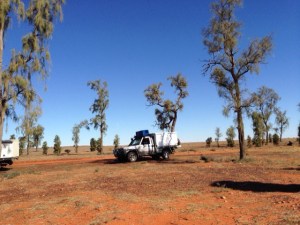
Acacia Peuce Reserve

Acacia Peuce Reserve

We stood and marvelled at these tall spiky trees standing in red earth encrusted with glossy black stones.   They looked a little like pines, or she oaks, but their leaves were not pliable.  They grew steely needles, like animal spines.  Yet their seed pods were pale green, like snow peas, and almost succulent.   A remnant of the tall forests that shrouded this land in days gone by.

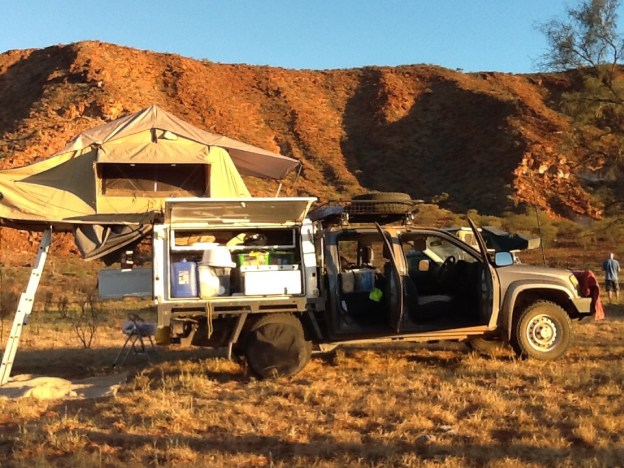
With still 200 km to travel to Alice Springs, we decided to find a camp spot just off the track. Howard spotted a site nestled below towering rocky sandstone hills.  The convoy stopped to make camp.   We watched the colours change in the sky as the sun went down, while Howard and Malcolm scaled the rocky heights above us.


Bush Poetry #3

By Christine Smith

The softness of a dressing gown
Dyed in the hues of the desert
Suzanne, yes I did notice
Your nurturing hands releasing
Our survival kits to adventure
“Bon Voyage would-be Diggers”.
The Prison of Warwick weeps
Across lushness, green
Who invented the bars of exclusion?

Autumn leaves scatter with tourists roaming
That extra H of Hahndorf
Echoes the bells of Europe
The gulping of beer,
The ode to holidays
Tempts the thirst
Across hills of vineyards
As the Pen folds onto the
Chalice of Cab Sav and twisted sheets

Lutheran dreams and Hans Heysen landscapes
Where knarled Herbnick eyes gaze hollowed,
as the Cornish leave rugged cliffs for
Their burrows to copper as we
Would be Diggers are lulled by giant wind gods
While McCartney unplugged harmonises
With Ulolooloo, Orroroo and Wallaway hey hey,
Cupp’d or cocktails? Hey hey hey!
Yes, I am serious

The hub of the Flinders
Is not the Hawker of barking dogs and whinging toms
But Jeff Morgan’s palette of
Sharpened ridges and smokey grey ranges
Compared with undies drying on the dash
Framing a landscape
Is this the moon?

Roads forget their fences as
I breathe in wilderness
Brachina gorge collects 520 million
Years of existence as trees
Line the hills like Sydney bridge climbers
No wilderness
Back on track
The land flattens like a
Giant pancake to laughing skies

Red gibbers shine their tongues to
The ancestors of rivers and wind
Farina beckons an ancient oven
Of cream buns and
Hollowed corridors embrace ceilings of stars
A heart broken mother in the loss of your son
Beloved sons and daughters
This is the wilderness
The breath of the Outback.

Christine Smith


Simpson desert dreaming

One week on the road. Our normal lives feel so distant, it is hard to imagine being anywhere but here.

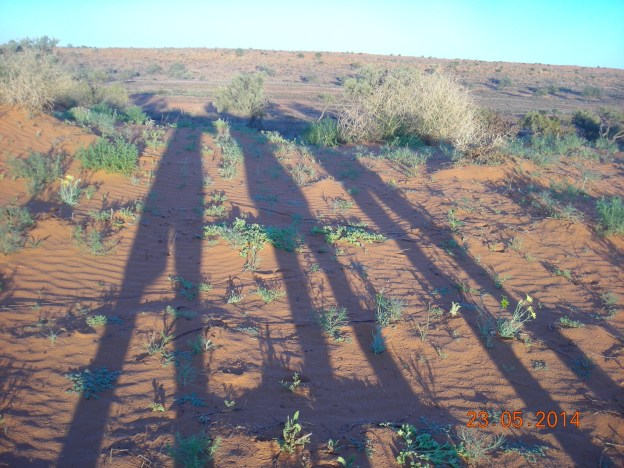
The desert grows more beautiful day by day. The rippling sand dunes are now covered with lush green vegetation. Recent rains have brought the desert to life. Two jet black eagles sit regally on a dune, watching us pass by. Their dark forms silhouetted against the red sand. Smaller birds twitter as they fly through the desert’s wild flower meadows. Flowers, grasses and small acacias populate the dunes, artfully planted it appears, as if to win a native garden show.

Rippling sands

Rippling sands

The bleached tops of cane grass tufts sprout like whiskers on the banks of the dunes. Purple flowers blend with clumps of native spinifex. A solitary kangaroo hops slowly away then turns to watch us from his garden home. There is plenty here for us all, he seems to say.

This truly is a botanist’s paradise. I lose count of the different species of flowers, shrubs and trees that we pass by. Bright yellow flowers dominate entire dune banks. From the viewing point on top of the higher dunes we see the desert garden stretching far into the distance on all points of the compass. Grey, green, yellow stripes on powder red sand.

Desert sands

Desert sands

Look, a dingo, clearly visible with her blonde fur against the colours of the desert. She looks at us, tongue lolling from her mouth, then walks away. There is plenty here for us all, she seems to say. Food is abundant for plant, animal and bird life after the rains.

As we drive towards Purni Bore, where we will eat lunch, we notice the land flattening. We are not yet out of the desert, but we are leaving her heart behind. We enjoy the luxury of a new shower and toilet block at Purni Bore and then drive on the flat pan, away from the dunes.

The soft sand is but a memory as we travel on rock strewn roads through the flattest country. In the distance we can see the flat topped mountains of the Emery Range. Our tyres are soft. The pressure was reduced to drive better on sand. We now begin to grow concerned that the rocks may cause a puncture. As it happens, the only casualty is our sand flag, that flies away, heading back to the desert’s heart. We understand the desire to return.

We drive forward on the rocky roads to Dalhousie Springs. The hot springs here are naturally created by water being forced up from the Great Artesian Basin that lies below us. This water is heated by high temperatures in the earth’s core and emerges at the surface at a comfortable 36-38 degrees. Time for a hot bath! We jump in and wash off the desert dust.

Out of Dalhousie Springs the roads are corrugated and rocky. It’s is not a comfortable ride. We stop off for a brief respite at Opossum watering hole. A sign reminds us that this is a significant place for aboriginal people. The magical stories of the Dreaming converge on watering holes such as this that have been used for thousands of years. It is easy to understand why.

Back on the rocky road, shaken but not stirred, we drive the last stretch of the day to Mount Dare. The red clay roads are deeply rutted. A final driving challenge before we camp and enjoy the hospitality of the Mount Dare Hotel.

Bush Poetry #2

Legs of the desert
by Max Smith

Over the rolling sand dunes
In a land that’s deemed so harsh
With a band of intrepid travellers
That all came from Deans Marsh

Through grit and determination
And working as a team
The achievement of these people
Was something to be seen

From dodging rutting camels
And eating such hard cakes
The lifting of ones spirits
Is what this land doth make

While sitting round the camp fire
When all of us are at rest
The joy of meeting new faces
And being put to a test

Will always be a memory
Until I’m laid to rest.

May 2014

Simpson Desert Day

Today is our second day driving through the Simpson desert.

I can share with you, dear reader, that it is unusually beautiful here. The colour of the sand, which varies from a creamy tan to a dusky pink, is a constant contrasting backdrop to the greys, greens and yellows of the vegetation. Wildflowers are unexpectedly prolific. We are lucky to see the desert in bloom. Flowers of yellow, white and mauve compete for attention with wattles decorated with yellow pompom flowers, with the complex geometric shapes of clumps of sand hill cane grass and spiky tufts of spinifex. I take hundreds of photos. I want to capture the memory of these sights and savour it forever.

We are not alone here. The desert is alive, but we see few of its inhabitants. The sand is traced with a multitude of prints, giving away their secret nocturnal existence. Dingo tracks follow the road for many kilometres. Tiny birds fly from bush to bush. Emus are spotted walking across the sands. A lizard slithers by. The ecosystem is alive and well, thriving on recent rains.

Our vehicles are tested by the harsh conditions and relentless low gear four wheel driving. They rock and roll as they climb the dunes. They shake and rattle as they twist and turn and any loose items are thrown about inside. A milk container is cracked, glass and plastic broken. Batteries fail and fuses blow. Fridge contents are thrown around as if in a blender. But the utes drive on, revelling in an opportunity to exercise their full capabilities. Few road cars ever have this work out.

We travel slowly at approximately 20 km/hr, looking out for other vehicles coming towards us on the track. Through the day we meet seven vehicles driving from West to East, the opposite direction to us.  Nearing the end of the day, a large sand dune stops Howard in his tracks. As he is reversing down, an oncoming vehicle appears on the crest above him. A close call.

This last dune is going to be a difficult one to climb.  It is deceptive.  Approaching what appears to be the top, a second hidden summit emerges.  It is two dunes in one. The sand at the top is soft. One by one the vehicles attempt the climb. First hard right, then hard left. After a few false starts everyone but Max is over. The V8 roars and here he comes, up to the right, then to the left. A glimpse in through the windscreen and we can see Max relaxed, a cigarette in his mouth, totally at ease as he twists the wheel and the Landcruiser ploughs through the sand to reach the summit. A cool customer.

The shadows are long in the late afternoon sun and we stand on top the dune for a while to take in the view. The desert stretches out below us. A spectacular end to another perfect day.

Bush Poetry #1

Poetry around the camp fire

I’m in the desert
The Simpson Desert
We’ve travelled many miles
I’m sitting in the sand
Red sand
Big red is in the distance
It seems it must be conquered
And conquer it we did
Clumps of grass and acacia dot the dunes
Flies annoy my eyes
The sky is blue and goes on forever
Horizon too seems far away
I gather up my sticks and play.

by Beryl Bush

Birdsville to the Simpson

The sound of dingoes wailing like banshees breaks the silence of the desert night.  We are in Birdsville.  Today we venture into the desert.

Sand flags are attached to our vehicles and straps are checked and tightened to make sure everything is ready for the desert crossing. We take a trip to the tourist information office to buy our desert parks pass and we are ready to go. A refuel at the servo and a detour past the bakery for a coffee and cake is all we need to set us up for the journey.

Birdsville has lived up to its reputation. A friendly place with every facility a traveller could need. It may be a remote destination, but it has the feel of a real town with a strong community.

Big red road sign

Big red road sign

A few kilometres outside the town, we stop for the obligatory photo beside the road sign to Big Red, the famous sand dune. Big Red is the highest dune in the Simpson desert, standing at around 50 metres. It lays down a challenge to our drivers that they are keen to accept.

As we prepare to leave the photo spot Brett and Christine find their ute will not start. A dead battery is the cause. We thank the desert gods that the battery has failed so close to town, where it is easy to buy a replacement. Out in the desert this would have been a more challenging problem to solve. Back to Birdsville we go. It does not take long. Battery purchased, fitted and tested and we are off.

The Simpson Desert is the world’s largest parallel dune desert. It is made up of over a thousand parallel dunes running along its length from NE to SW. Our route will run from E to W, along the QAA line to Poeppel Corner and then along the French Line to Mount Dare Hotel. We will be moving across and over the dunes and will have some challenging 4WD action ahead of us.

Sand dune

Sand dune

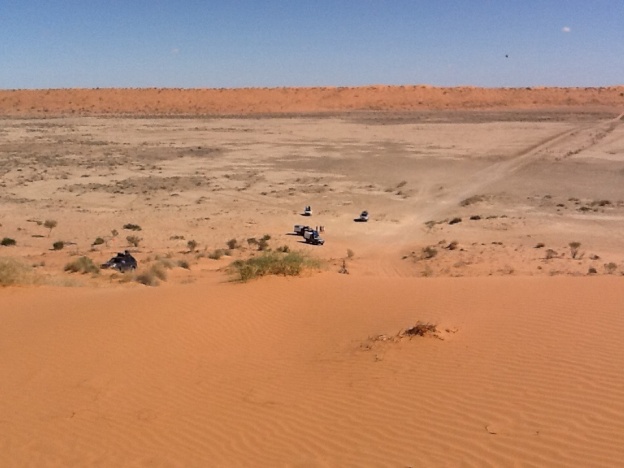
The first sand dune is relatively easy to climb, but we novices feel a surge of excitement when we successfully reach the other side. Next comes Big Red. It is slightly off the main track, and is not on our route, but it is definitely on our itinerary. We take the side track towards it, see the dune ahead and the adrenalin starts to run in anticipation. Howard is first to attempt the giant dune. He easily reaches the summit on the second attempt. We see two figures at the top, watching the rest of the team’s attempts. Max hurtles towards the dune and loses power about three quarters of the way up. He reverses back down and powers back for his second attempt. He does it. He and Heather stand at the top looking down.

Malcolm and Olive try twice unsuccessfully to climb the dune, but they have conquered it before and decide to sit this one out. Brett steps up to the plate and powers up the sandy incline. The ute loses power in the middle of the dune. He tries again and gets almost to the top, but can’t find the traction to get through the soft sand at the summit. He decides to call it quits. It’s been a tough day already and he will pass on this challenge.

Tackling Big Red

Tackling Big Red

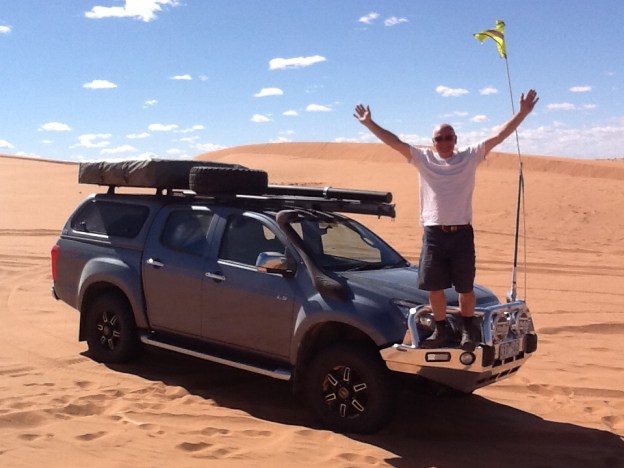
Richard lines up to take his turn. He charges at the dune, wrestling with the wheel to stay on track, only to lose traction midway. Four more attempts in different gears see him climb to the very top of the dune, only to lack enough power for the final push over the crest. Another group of vehicles approaches the dune and he knows he only has time for one more try. He is determined to conquer the colossus and his face is set as he lines up for his attempt. The radio crackles with advice on the gear to select, “Low 2”, “High 3”. He selects low 3 and manoeuvres the ISUZU to the starting point. At the last minute he flicks off the air conditioning, hoping that might help him find the extra few horse power he is looking for.

Off he goes, power on, up to middle of the dune, the vehicle gains traction as he turns to the left and the ISUZU pushes forward, finally easing over the crest and on to the summit. A shout of exhilaration and he’s out of the vehicle, punching the air. Mission accomplished.

With the excitement of Big Red behind us, we continue our drive into the desert. Every dune presents a different driving challenge. The convoy soon gets into the groove and we make slow but sure progress through the afternoon.

Map

Map

Beryl calls out over the radio, “We’re in paradise!” We climb the dune to find a treed plain below us that reminds me of an olive grove. The flat plain between two distant dunes is dotted with silvery grey green trees. We have found our first desert camp site. Wood is collected, a fire is set and we make camp.

After a tasty dinner, we sit around the camp fire, looking up at the starry starry night. Earlier in the day, Beryl had laid down a challenge to the group to each write a poem to read around the campfire. What a talented group! The poems each reflected the personality of the author – some comical, others lyrical – all giving a new perspective on the trip so far.

I will share a selection of these poems in future posts under the category “Bush Poetry” so that you, dear reader, can hear other voices tell the story of our travels into the red centre of Australia to see the Big Red Bit.