Tag Archives: Australia

The Rock

Uluru has power.

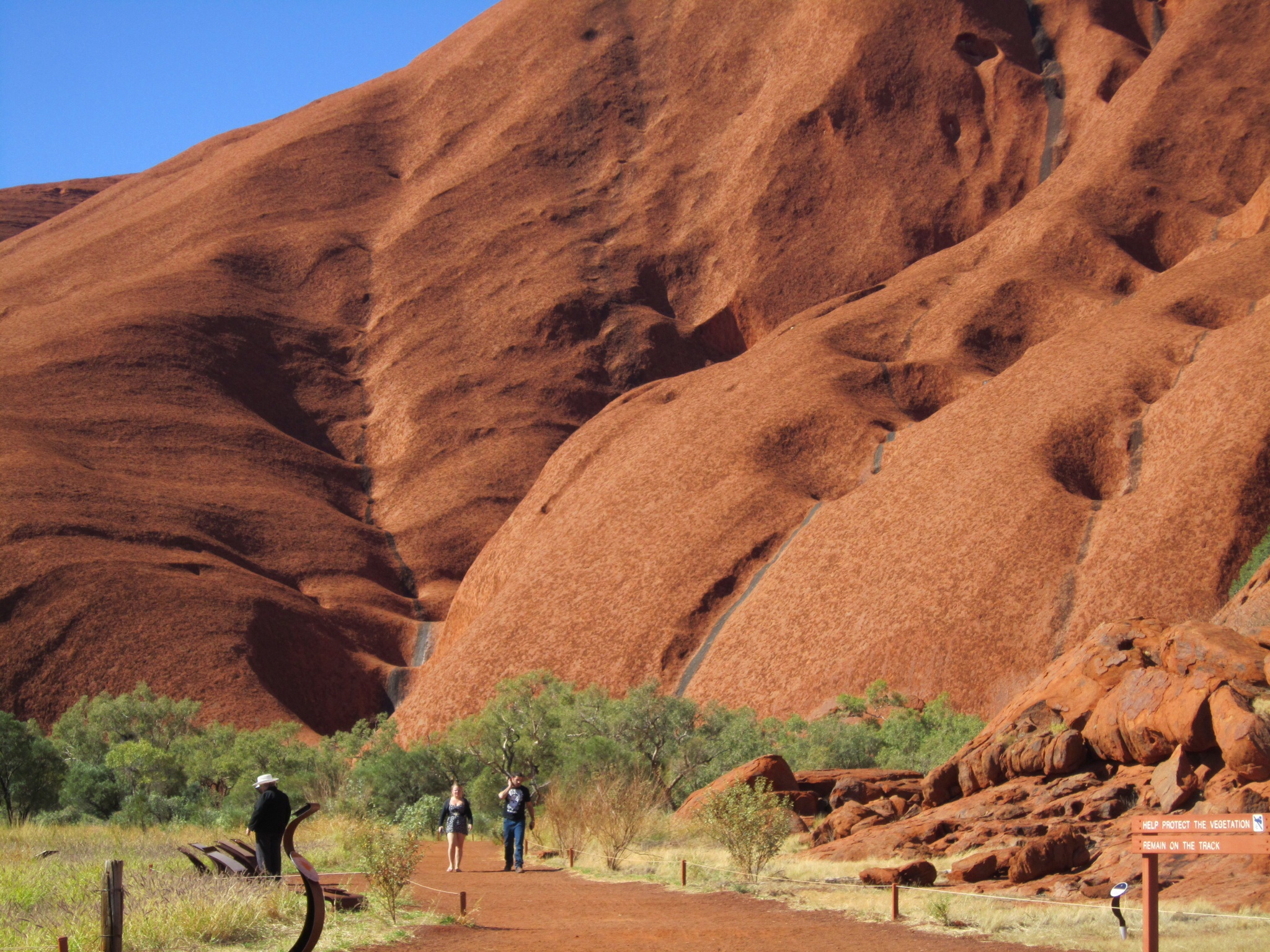
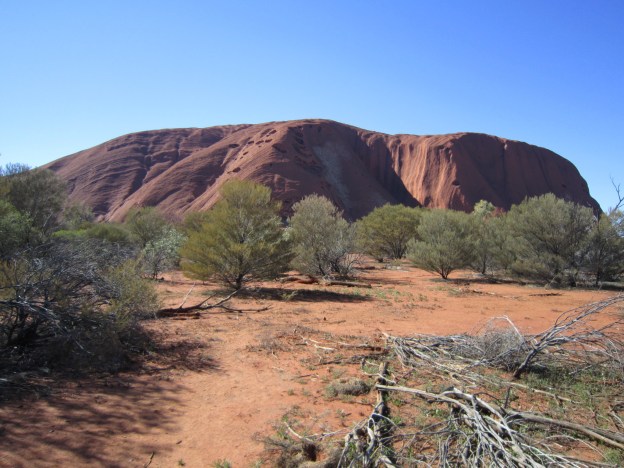
When I first saw The Rock, I was mesmerised.    It’s such a familiar sight, from a million photos, postcards and paintings, but in the flesh it has power.

It is a deeper, darker red than the surrounding powdery pastel red desert sands.   The shadows that fall where the rock folds are dark, almost blue.   The Rock is much more complex, more textured than it appears in a two dimensional image.

Close up it is a huge impassive presence.   I listen, as if to hear its voice.  I imagine it booms silently in the deepest bass. It vibrates with the deep throaty grumble of a didgeridoo, just outside of our hearing range.

Uluru wave

Uluru wave

This monolith is full of curves and craters.   It is ribbed.  It is cloaked, draped with a soft red sandy velvet cloth.

Huge empty pools wait for rain to fall, to fill and spill in giant stepped waterfalls.   Water leaves its mark, dark stripes painting an image of a wet Uluru in dry times.

Curves

Curves

Uluru has caves, waves, an open mouth.  It is honeycomb.  Barbara Hepworth, the Cornish sculptress, comes into my mind.  I see some of her curved stone shapes here, but her wildest dreams could not have imagined sculpting these forms and shapes on one piece of rock.

Shapes of Uluru

Shapes of Uluru

It used to common for tourists to climb the rock.  We look up, but do not see any tiny figures on this massive structure. The authorities have moved further and further towards a no climb policy.  The fragile hand rail can be seen on the face of the rock, but the climb is closed.  It is closed when it rains, when it is hot, when there is more than a 5% chance of a thunderstorm.   Soon it will not be possible to climb at all.   The Rock is sacred to the local indigenous people.  It is right that we respect that.   There are plaques in memory of those who lost their lives attempting the climb.  It is better this way.

Watching Uluru at Sunset

Watching Uluru at Sunset

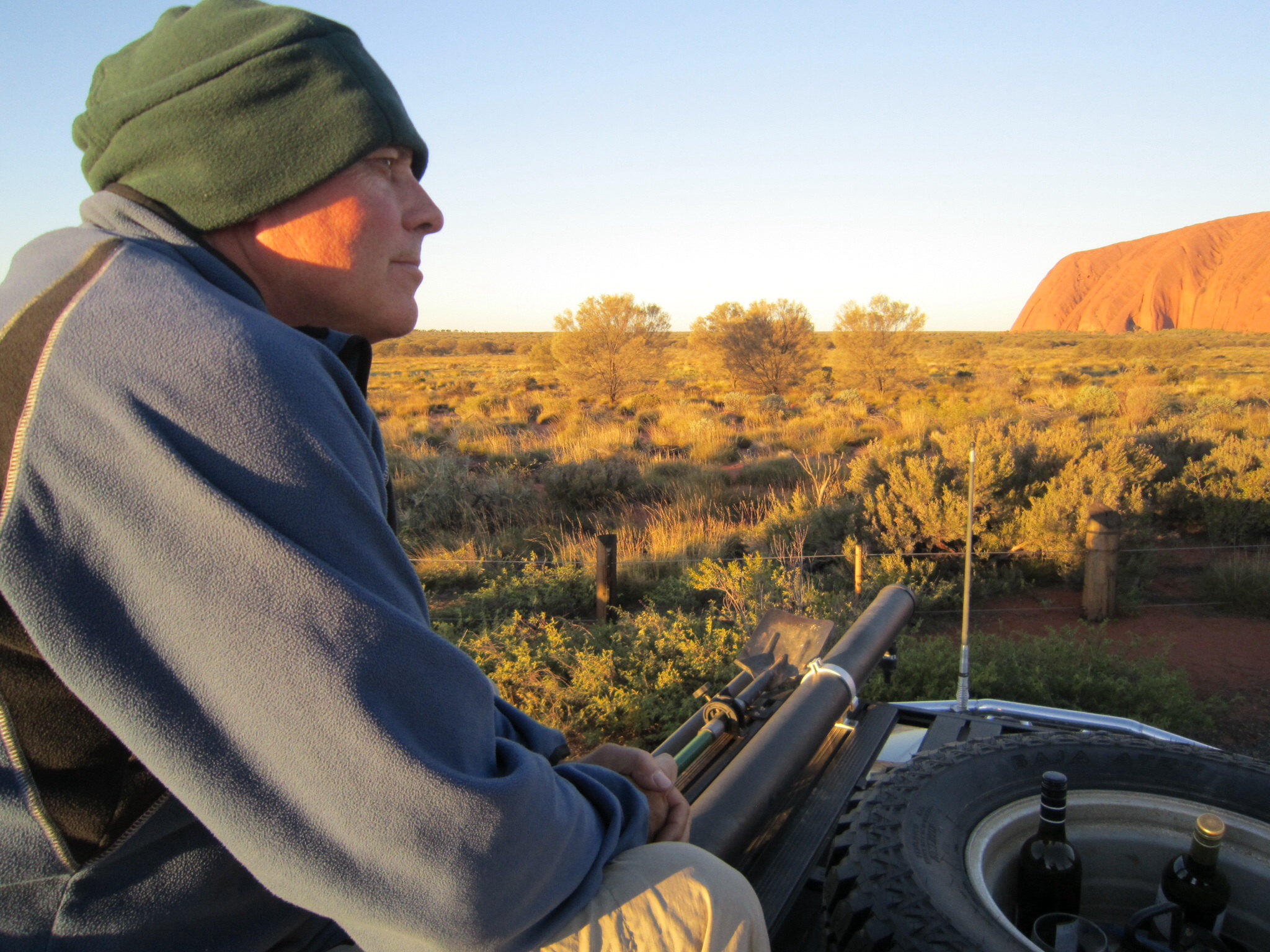
We sit on top of our roof top tent at the end of the day and watch the sunset play with the colours of The Rock.  It glows golden with the dying light, then darkens to a burgundy blue.

Uluru glows at sunset

Uluru glows at sunset

We raise a toast, “Uluru has power”, borrowing a line from a favourite John Williamson song.


Kings Canyon

Walking boots, sunglasses, water bottles? Yes. We are ready for the Kings Canyon rim walk. A stiff breeze keeps us cool as we make our way to the start.

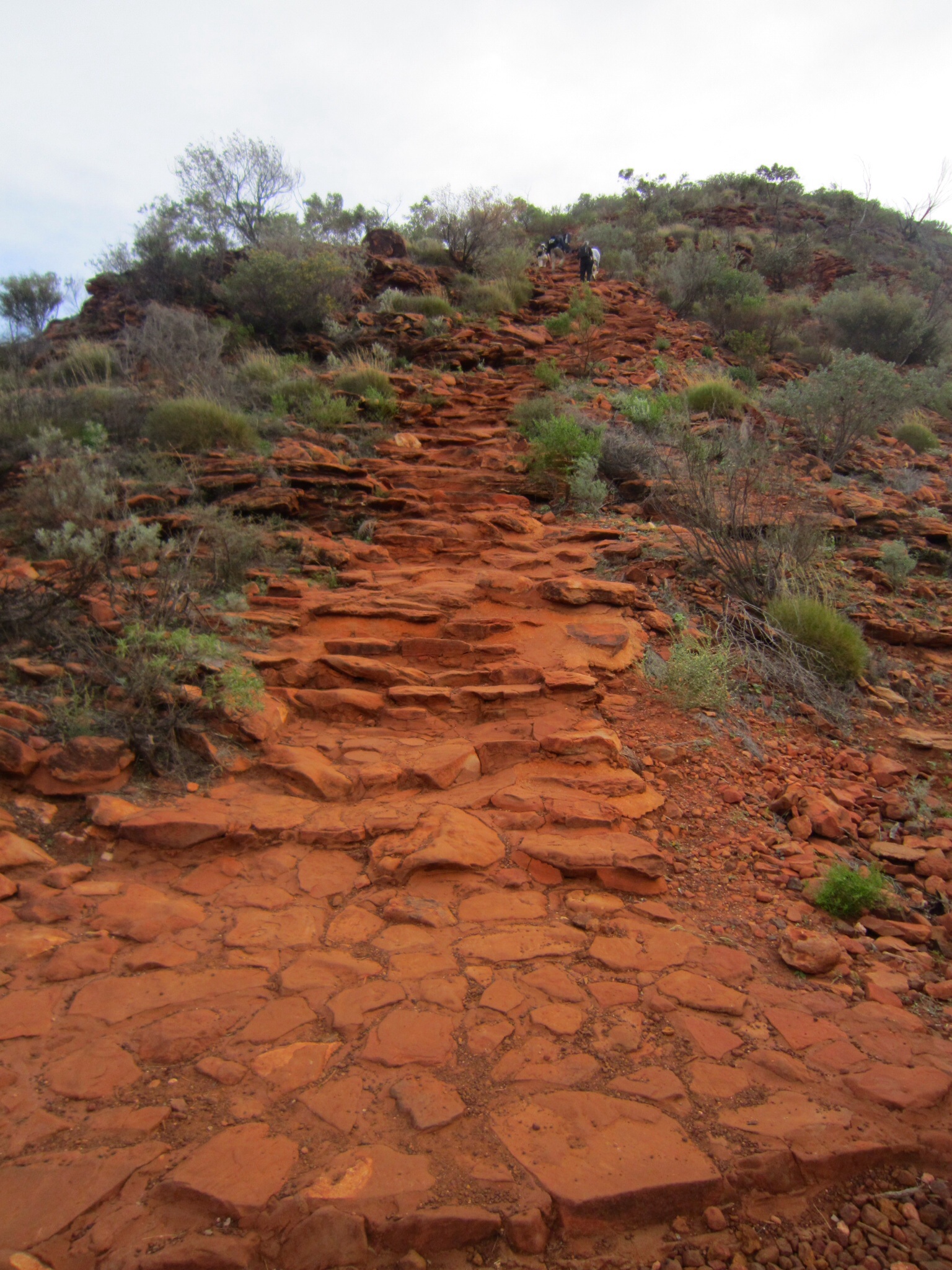
I look up and point. “There’s someone climbing the canyon wall”.

“No. That’s the path”, says Richard.

Up to the rim

Up to the rim

Up we go. The track climbs almost vertically from ground level up to the rim. It’s steep, a five hundred step climb. Hearts pumping and slightly breathless, we get to the top.

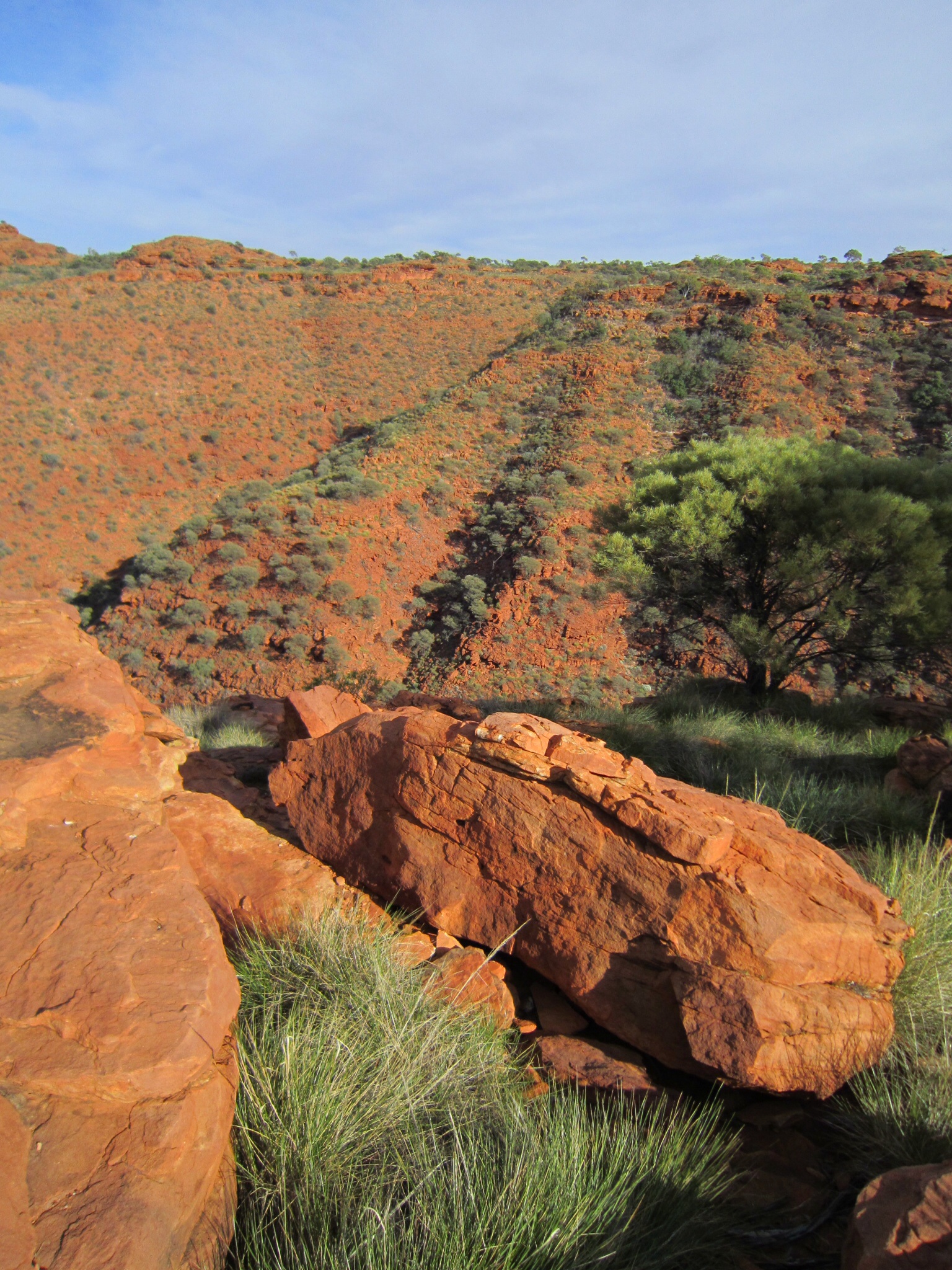
What a view. We can see for miles and miles across the spinifex plains.

The rust red golden hues of the canyon surround us as we walk further along the rim. Massive rocks with tessellated angular surfaces like crocodile scales, loom ahead. Hardy white cypress pine trees force their roots deep into crevices in the rock to find water to survive. Palm like cycads sprout from rocky corners. The rim has its own thriving ecosystem, including rock wallabies and euros. It is surprisingly green up here.

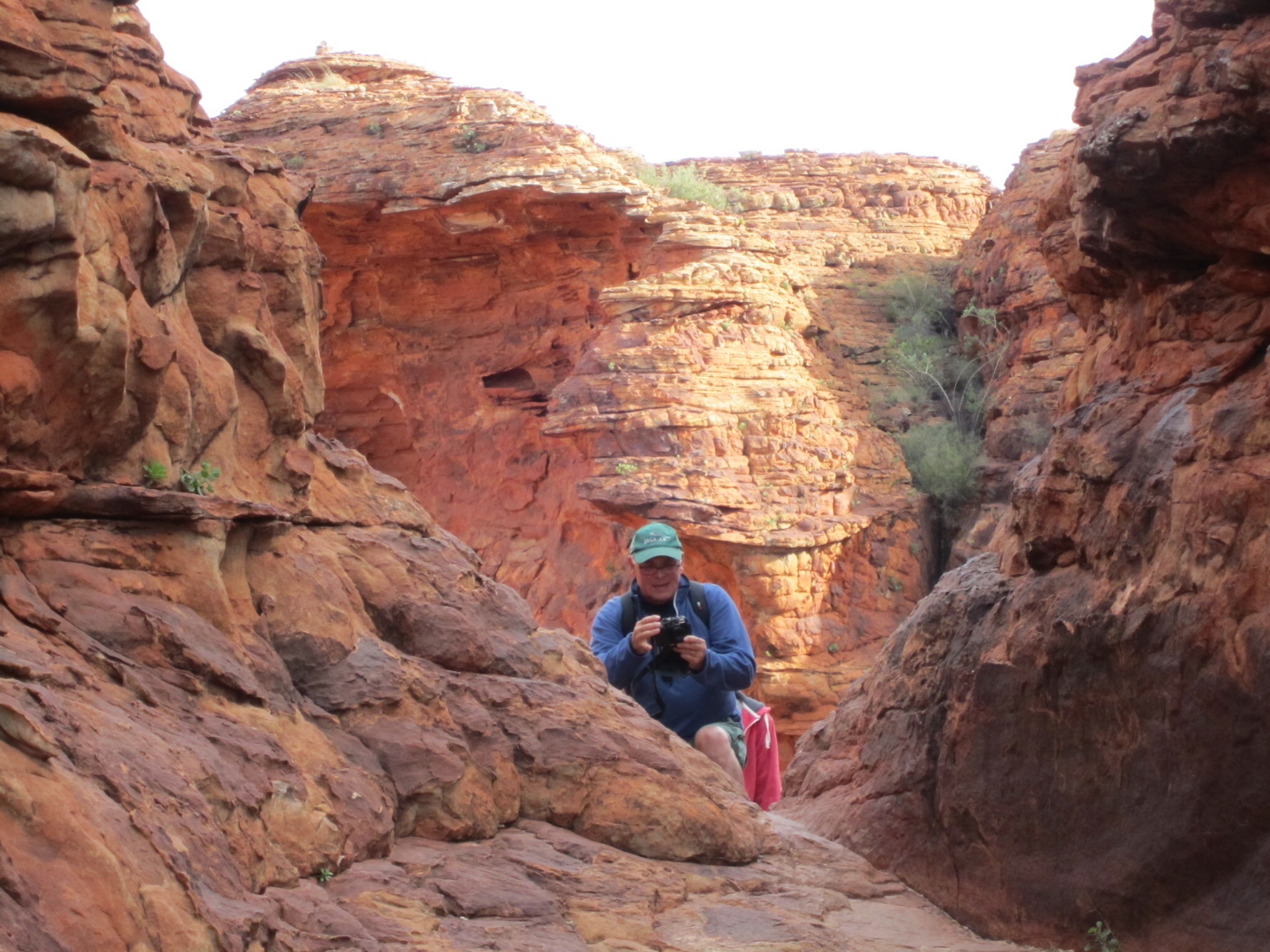
Richard in Kings Canyon

Richard in Kings Canyon

The path takes us through a narrow space between two huge rounded masses of rock. We catch glimpses of strange otherworldly shapes on the other side. When we step through we are transported into a forgotten village of beehive shaped stone dwellings. The flat rock at our feet could be a man made pavement from ancient times. I touch the rock, to reassure myself that this is real, not a dream. Where are the ancient people who lived here? I see why the local people tell tales of a dreamland race who live here in the rocks.

Red holly grevillea grows here in profusion. A beautiful plant, it has the delicate red flower of a grevillea and spiky, grey green leaves, shaped like holly.

I lean down to touch ripples in the rock at my feet. They are cold and hard. I am touching the frozen memory of wind rippling the dunes that formed this sandstone. I am travelling in time.

It is wild and windy. Cool bright weather like this is perfect for the walk. It is about six km walking on rocky surfaces with little shade. On a hotter day, the rock would reflect the heat of the sun and it could be unbearable.

Canyon view

Canyon view

We are totally immersed in the world of the canyon rim. Everywhere we look we see the intense rust red colours and strange, awe inspiring structures sculpted by the wind and rain. I’ve never been anywhere like this before.

The path takes us to the edge of the canyon and we walk down a black wooden walkway into the chasm. Below us we can see the creek. We look down on the tops of tall gum trees growing out of the lush green oasis created around the waterway. Birds are singing. They call this place the Garden of Eden.

Canyon wall

Canyon wall

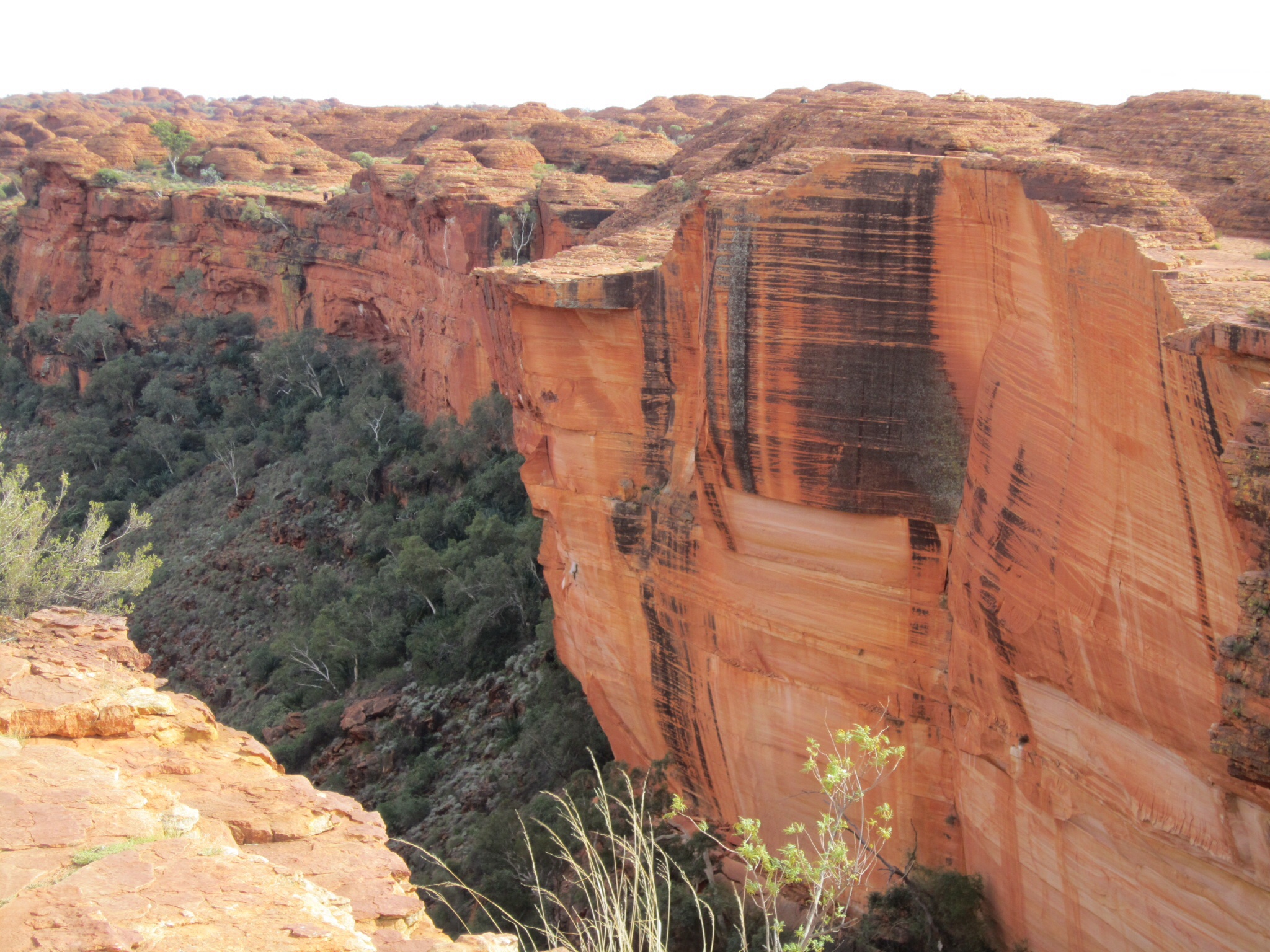
Climbing again to the other side of the rim, we catch a view of the walls of the canyon. The craggy rock has split through to form a wall that is flat and smooth, as if a knife had cut it. The heart of the rock exposed is paler than its craggy skin suggests. The flat walls are amber and white, contrasting with the deep red gold around us.

Two small figures can be seen on a precarious rocky ledge opposite us. Some foolhardy tourists have diverted from the path and have clambered down on to the edge to get a better view of the walls of the canyon. I feel my stomach dip in vicarious vertigo. From our vantage point we can see that the rock breaks away beneath them and curves way back into the wall of the canyon. What madness.

We walk on, way back from the edge. The flat rock catches the rays of the sun and glows. The camera will not be able to capture the intensity of the colours around us.

Canyon walk

Canyon walk

We glimpse the view in gaps between the hard glinting surfaces of the towers of red gold rock. It is as if we are looking into the dreamland world again. We see a plateau apparently densely populated with stone villages from another time and place. The beehive shapes intrigue me.

The walk begins to descend and we catch sight of the car park far below us. Gradually we climb down from the rim leaving that strange, beautiful world behind us.

The red centre is a wonderland. Every day we are in awe of the land around us. Tomorrow we visit Uluru then Kata Tjuta. No doubt I’ll fall in love with them too. But it’s the landscape as a whole that inspires.

Travelling long distances, I see the beauty in the ever changing shape and colour of this country in its natural state. It’s a rare privilege. Most of the landscapes we see have been so manipulated to our needs that we have lost this. We’ve lost the horizon. We’ve lost our connection to the natural world.

I’m not suggesting that travelling in a car over long distances is the best way to get in touch with nature. Of course not. But the real attraction of the red centre for me has been the ability to see not just the tourist sights but the form of the land itself. Walk it, cycle it, drive it, fly it, it doesn’t matter. If you travel in this country you have an opportunity to see natural beauty without human intervention and on a grand scale.

West from Alice

We start the day with hot milky coffee from a tiny cafe in Alice Springs. Today we drive west.

Our route follows the West Macdonnell Ranges out of Alice along Namatjira Drive around the Mareenie Loop and finally to Kings Canyon. We are driving into the heart of Australia, the true red centre.

The ranges stand tall above us, red and rugged. Their scale is immense. Once again I am in awe of this landscape. The red centre is everything I imagined and so much more. On our left the Macdonnells extend far into the distance, their pointed peaks like the serrated edge of a giant saw. To the right the country rolls in a softer female form. Gentle green-grey curves hide the rock underneath, as if a blanket has been thrown over the bony peaks to protect them from the winds.

The sun climbs in the sky, it’s a cool, bright day west of Alice.

The road has been paved and marked with clear white lines to ease the way for day trippers. It’s a comfortable, but unexciting drive. We see a sign for Standley Chasm and turn in to take a look. I’m in two minds about this place. The natural beauty of the chasm is visible, but it has been tainted by handrails, walking paths and a poorly positioned waste bin. A phrase comes to me, “taming the wild”. The chasm is just too close to Alice.

We drive further west. The Macdonnells stay with us, constant companions guiding us on our way. I’m intrigued by a sign for Ellery Creek Big Hole. It’s not a romantic name, but it’s time for a cuppa so we park and take a look. We stroll down the walking path admiring the wildflowers and the red black cubist shapes in the rock faces ahead of us. Then we stop, stand and stare. The “big hole” is the waterhole of your dreams.

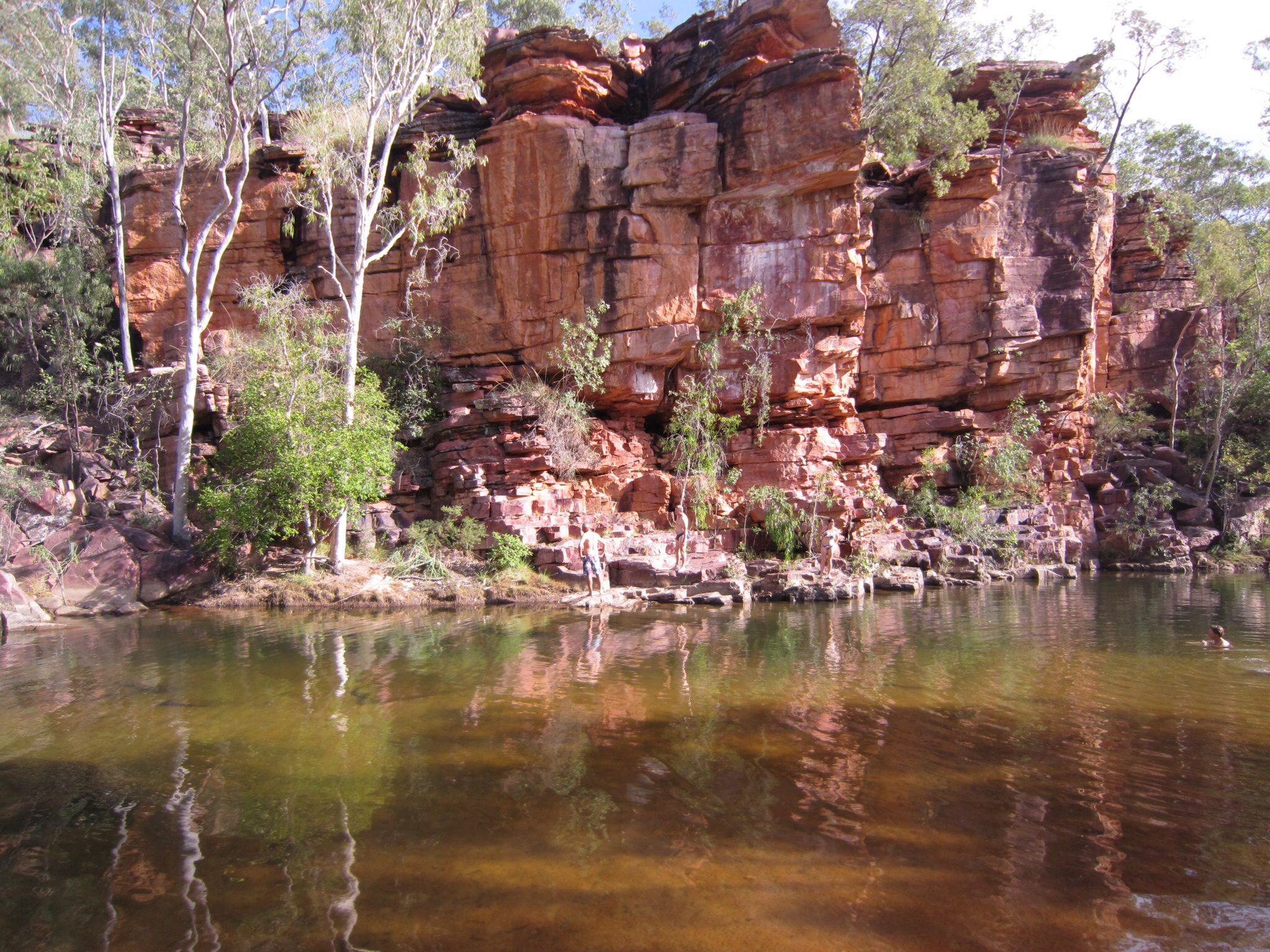
The craggy red sandstone walls are reflected perfectly on the surface of the deep dark water. The water is cold, too cold for a swim. A fish jumps, sending ripples across the width of the pool. A ghost gum stands to one side, white limbs leaning like a hesitant swimmer over the water. The water continues through a small passage in the rock and on into the distance. A canoe, and some more time, and we could explore. Perfect.

On our way again, it suddenly feels strange to be travelling alone, without the convoy. We miss the banter on the radio. We miss sharing the beauty of the waterhole with our travelling companions.

Fewer and fewer cars pass by. We begin to distance ourselves from Alice. We are once more in the outback.

The ranges running alongside us become a living aboriginal painting, grey green dots of spinifex against a yellow and red ochre background. The lines formed by the terraced structure of the rock create a wave effect, undulating through the ranges.

We take a detour to look at the ochre pits, where the local people have mined ochre for thousands of years. Imagine the white cliffs of Dover striped in gold, green, white, red and yellow. The walls of the pits are vivid with these earthy colours, red and yellow with iron oxide, white with lime. The colours lie in waves and stripes showing how the seabed that once lay here has been twisted and turned by forces from below.

It’s way past time for lunch and although we need to keep moving to get to Kings Canyon before sunset, we decide to stop at the next rest area.   It is a lookout.  We climb to the top of a steep incline that levels out to give a panoramic view around us.   The plains below are green and grey with spinifex and white cypress pine. That’s when we see Tnorala for the first time – a circle of red rock, like the crater at the top of a volcano.  I find out later that Tnorala is the imprint of a celestial body that fell to earth millions of years ago.  Wow.

We drive down to take a closer look.  A sandy road takes us inside the circle of rock, sheltered from the wind. This is a special place.  Beautiful, yes.  But it is more than beauty that holds us spellbound.  There is a spirit here that is soft and gentle.  This a sacred place, and not just because the local people, the Arrernte, say so.   I can’t explain it, but I will remember this place in my dreams.

And then it’s fun time, we turn on to the 4WD section of the road, the Mareenie Loop. Hang on to your hats! The sand and gravel road that winds its way towards Kings Canyon is not for standard road cars or the faint hearted. It is slippery. The car slides around the wide road.  The driver needs to focus to keep us on track. I look at him. He’s loving it.

I shout “Dip!” as the road drops away suddenly. Just as well we upgraded the shock absorbers. Tight turns, sharp left, then sharp right, arrive with no warning.

The sun is low in the sky and long shadows fall across the landscape. It is stunningly beautiful, but Richard can’t risk taking his attention off the road.  The car drifts in the bends from one side of the road to the other before gripping the road again to drive into the next bend.   Can this be fun? I look at Richard’s smile. It says it all.

We are both tired when we arrive at Kings Canyon Resort.  It’s been another unforgettable day.

Katherine Gorge, Land of the Cicada

We listen to our ranger guide. He tells us Katherine Gorge is Nitmiluk, Land of the Cicada.

I like the name. I can hear the cicadas chirping in it.

The park has thirteen gorges. We only have a few hours to spare so we decide to see two of them on a tourist boat trip.

Dying trees surround the jetty where we board our boat. They bend and sag, weighed down by fruit bats, or flying foxes. Thousands of the bats cling upside down to the branches, wrapping themselves tightly in their wings, like miniature vampires in their black capes.

Bats

Bats

A tourist wearing bright red lipstick, wrists laden with bracelets, shakes her head in disgust when the indigenous guide tells us they will leave only when they have broken down all the branches of the trees where they are roosting. “What pests!”

“No, no”, calls back our ranger guide. “It’s good for the trees. The bats prune them and fertilise them with their dung. They grow back to be much more healthy. When the bats have done their work here, they will move on and do some gardening for us further upstream. That’s how the system works. Everything has its place”.

The boat glides through the clear water between the towering amber red rock faces of the gorge. We shield our faces from the intense heat of the sun. The water sparkles and shimmers ahead of us. In the Wet, the water is 7-8 metres higher than it is today. The guide points out the marks on the sandstone rocks above us.

White, black and red ochre stains streak down the rocky walls, as if a giant artist has daubed paint brushes up and down in a frenzy of earthy colour. The rocks glow as we glide past, then darken as they fall into shadow behind us. Hardy trees sink their roots deep into crevices in the sandstone to find moisture and nutrients. Somehow they succeed and make their precarious homes on the rocky ledges above us. Twisted and knarled, they survive and provide shelter in the gorge for bird and insect life.

Freshwater crocodile

Freshwater crocodile

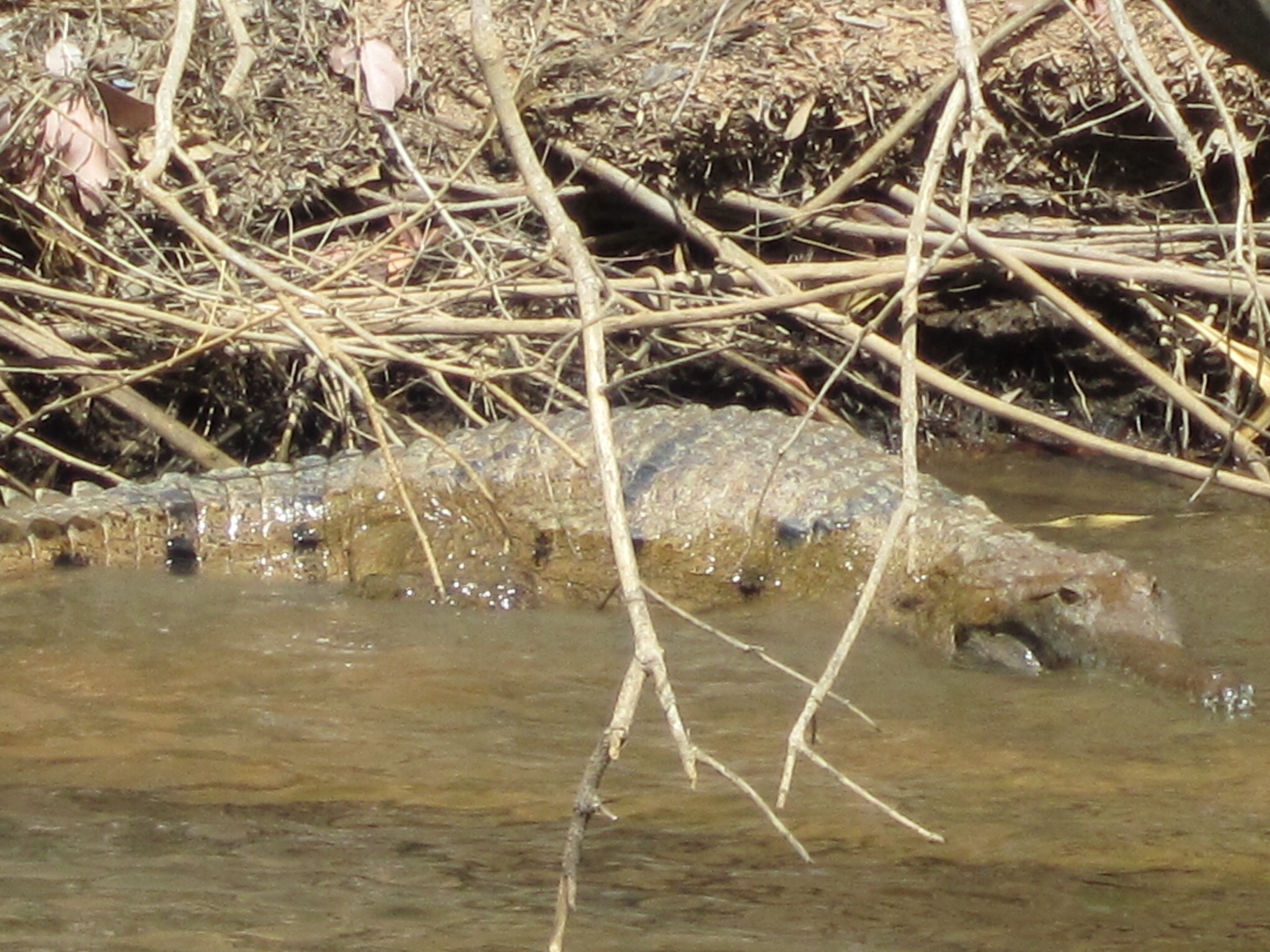
A crocodile lies snoozing on a small sandy beach to our left, her silvery scaled skin reflecting the sun’s rays. “Don’t worry, she’s a freshie, a freshwater crocodile. She won’t do you any harm. She might put a few holes in your arm if she’s rattled, but they only eat what they can swallow whole. You are quite safe”. I glance at the toddler sitting sleeping in his mother’s arms in front of me. Sleep safely little one.

Saltwater crocodiles on the other hand are extremely dangerous. “Salties” enter the gorge in the Wet, when water is flowing into the park from the estuaries where they normally live. Some of these prehistoric predators are left here when it stops raining and the water goes back down, closing off their exits. This is not great for tourism. The park rangers put out traps and relocate any they catch before the park is opened to tourists.

“We always feel a bit nervous when we send the first canoeists out there”, the ranger guide jokes. We all stare at the trap he is pointing towards and hope he really is joking.

We have to transfer to another boat half way through the trip, because the water is too low in the dry season to pass through to the next gorge. Our walk along the side of the gorge to reach the second boat passes an example of Jawoyn rock painting that is around 8000 years old. There are paintings dated 25,000 years old in other places in the park, we are told. They are some of the oldest artefacts in the world.

I find these periods of time almost impossible to imagine. The first fleet came to Australia in 1788, not much more than 200 years ago. We are so new to this land compared with our guide’s people. Our history here is recent even by our own Western standards. I sit and ponder this as we glide further into the gorge.

There are many paintings in the park that are kept secret as they mark sacred places. The painting we pass by is different. Rock art was also used to communicate information to travellers. It told them the type of food available and any fresh water nearby. We are reading signposts and tourist information maps from another culture.

In the second gorge the guide slips the boat into a small cave to one side. “Listen”. A high pitched squeaking sound reveals the presence of a population of tiny horseshoe bats. They snuffle around as we approach, keen to be left in peace to continue their siesta. They are the modest, shy cousins of the fruit bats we left back at the jetty.

Canoeists in yellow life jackets paddle by. Children shout and splash as they dive laughing into the water from a rocky ledge. Two men are fishing. The park is well used.

As the boat turns back towards the jetty, I look up in wonder at the beauty around me. It really is magnificent, how lucky we are that the Jawoyn have chosen to share it with us.

Adelaide River Races

We’re here!  4000 or so kilometres travelled across deserts, mountain ranges, freeways and unsealed dusty roads and the convoy has finally reached Adelaide River for the races. We’re in early to the show ground, choosing a shady area under some tall gum trees to set up camp.

We form a circle with the cars, like wagons keeping out the Indians in the Wild West.   From the comfort of our little compound we watch as the preparations for the race day get underway.  Food stalls are being set up.   Trees are trimmed.   Marquees are erected.

More campers arrive and the show ground gradually fills.   The first race is due to start at 2pm.   We kit ourselves out in the best racing finery camping will allow and head into the fray.

Young men with slicked back hair walk arm in arm with girls teetering on high heels.  The crowd is a glorious celebration of clashing colours and styles.   Denim shorts and cowboy boots stand next to satiny prom dresses in the queue for the first glass of chilled wine or beer.   Lacy fascinators wired into intricate swirling designs are perched atop freshly blow dried tresses.  Akubras add an outback charm to business shirts and dark trousers.

The setting is pure Australian bush.   The grass race track is surrounded by gum trees.  The scent of wood smoke is in the air from a bush fire the day before.  Plumes of smoke can still be seen in the distance.  The sky is bright blue with a few white clouds to shade us from the heat of the tropical sun.

Men drink beer cans branded XXXX or Bundy and Coke.  Women sip white wine from plastic wine glasses.   Corporate tents are filling up with the glamour set, while caterers work hard to prepare food for the masses.  There’s Asian style wok fried rice and noodles, pizza or roast lamb for the unaffiliated outside the marquees.

The racehorses are stabled at the back of the show ground next to the road for a quick getaway.  They are impatient to get out onto the racetrack, they paw at the sand and toss their heads.  Trainers hose them down with jets of cool water, leaving their lean muscled bodies gleaming wet in the sunlight.   As their turn comes to race they are led out with numbers fixed to their saddles to identify them to punters studying form.

Hosing down

Hosing down

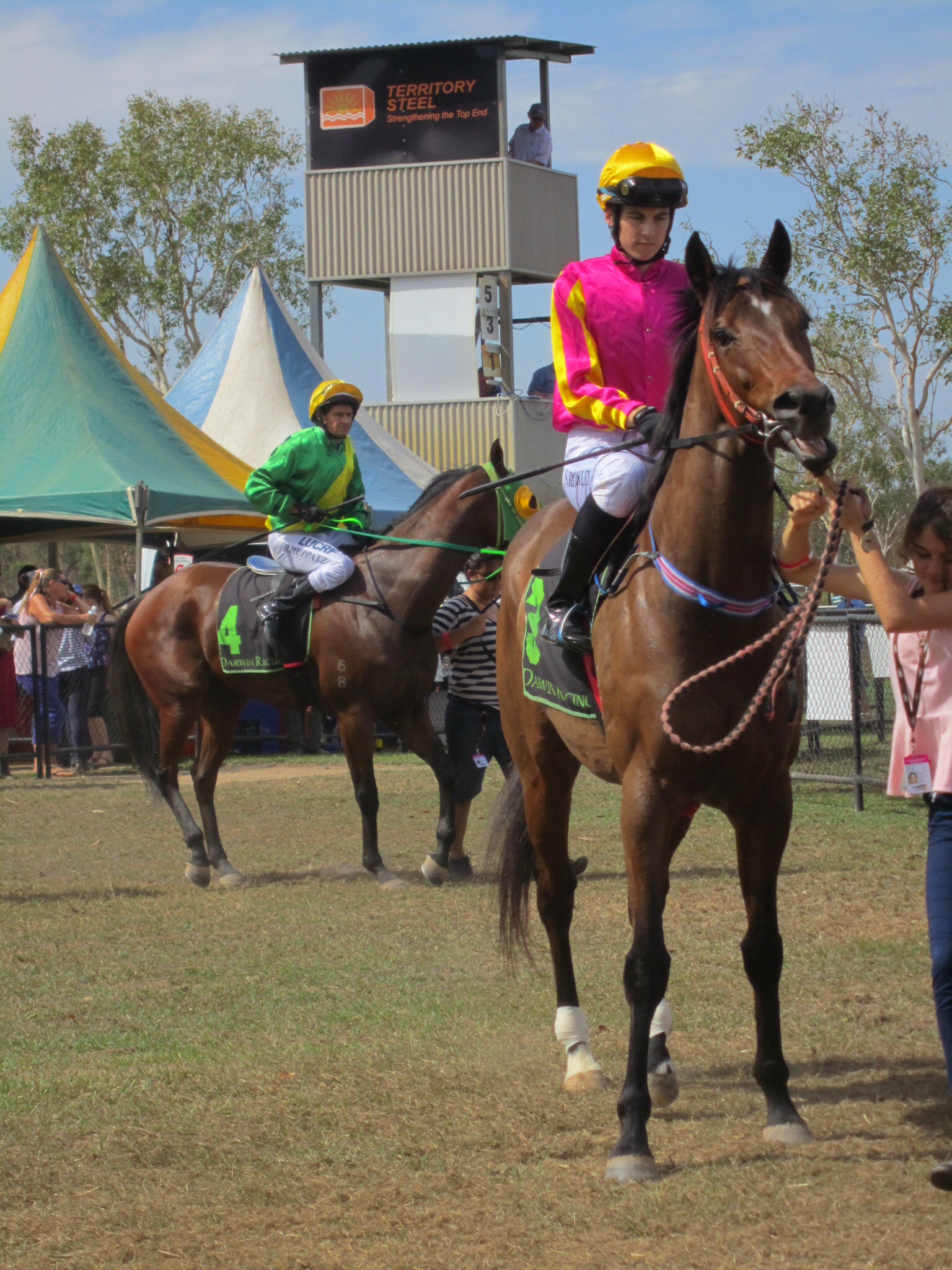
A jockey dressed in bright colours, pink and white like the galahs flying overhead, mounts a fidgeting racehorse who skips sideways as the small boned man grips tightly with his knees.  Animals and men feel the tension, it’s all nerves in the lead up to the start.   Race goers leaf through their form guides, pencilling in cryptic comments as they watch the horses circle in the mounting ring. “I like the grey” whispers the girl next to me.

Jockeys in mounting ring

Jockeys in mounting ring

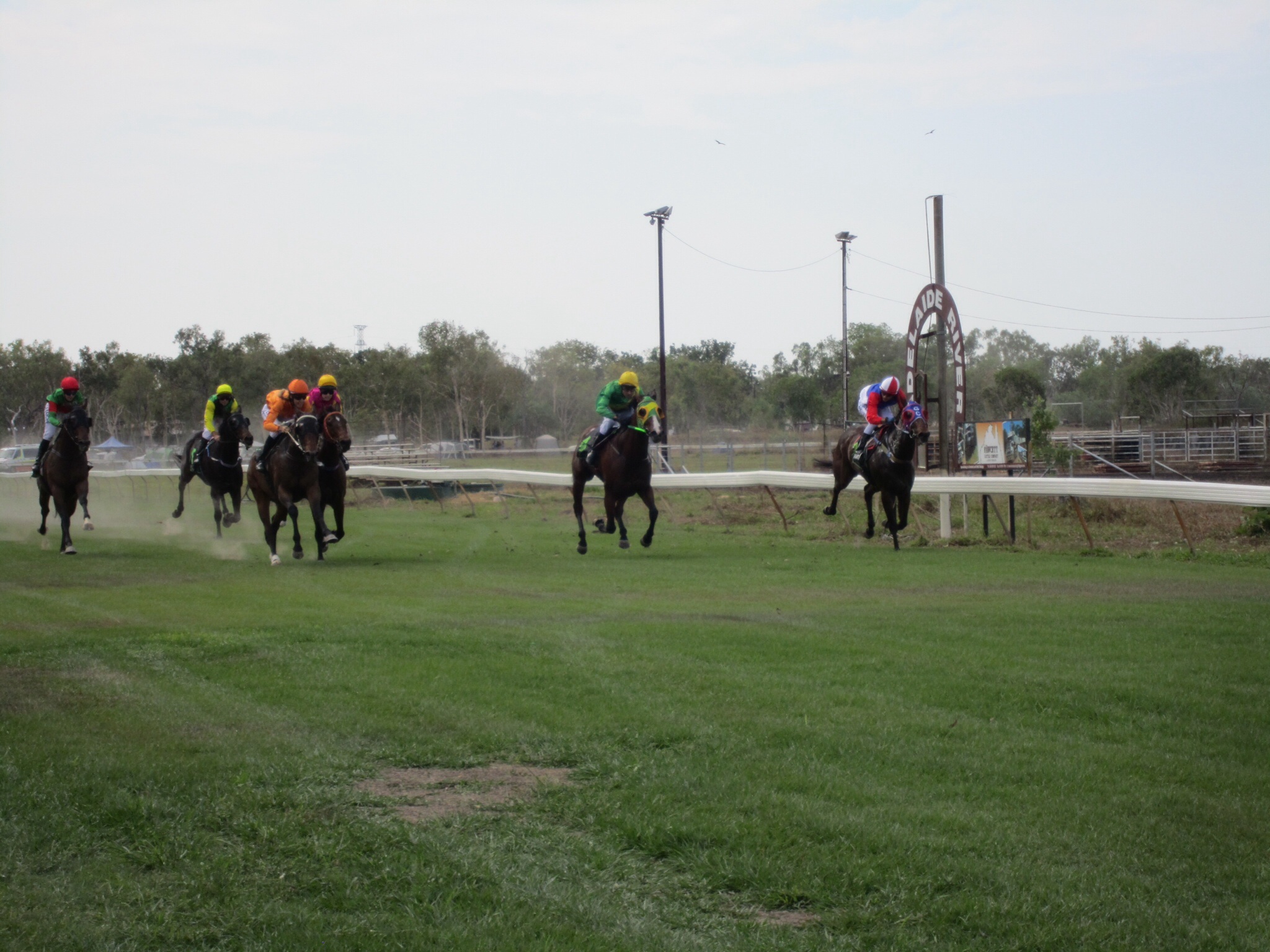
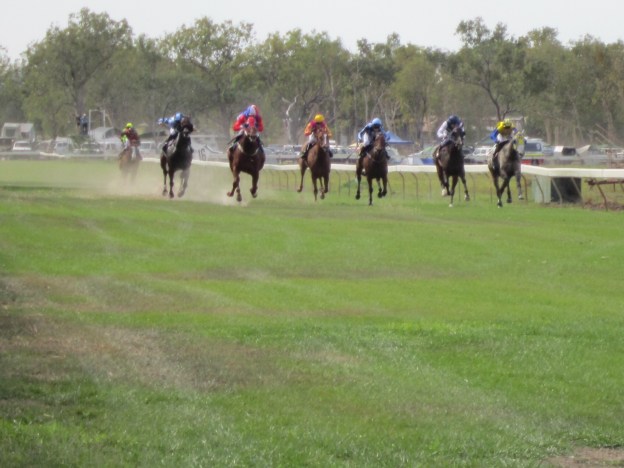
The loudspeaker on the PA system is working at maximum volume, distorting words and phrases and forcing us to shout to make ourselves heard. At first we are confused as races being held in other states are called out, excited commentary working itself to fever pitch of arousal before fading away as the races end and the results are known.  Then the first race at the show ground is underway.  We lean against the cold metal of the barrier to get a better look.   Hooves thunder around the track, horses flying through the air leaving a dusty haze hanging behind them.  They are magnificent beasts.
Finishing line

Finishing line

A man in an oversize hat punches the air.  His horse has won.   He listens for the confirmed results to crackle over the PA and hurries off whooping to collect his winnings.

I watch the whistling kites circle above us on the rising thermals as the heat grows into the day.  They swoop and glide, hovering over us to see if any little scurrying mouthfuls are disturbed by the human activity below.

It’s a family day.  A little chubby cheeked toddler in a pastel pink and yellow cotton dress scrunches up her baby face in offence when her daddy walks ahead of her, encouraging her to walk rather than sit in his arms as she would prefer.  She waddles after him with arms outstretched, sobbing, then is all smiles and kisses when he picks her up and strides away.

Bets are laid.  Money won and lost.  We are not big spenders in our group.  A few dollars on the nose.   A buck either way.   Beryl and Olive use their experienced horse knowledge to make some good calls, but we won’t make our fortune today.

Another race starts and I make my way to the barrier to watch.   They’re off.  As they gallop towards the finishing line I see a riderless horse running inside the circle of the racetrack.  His jockey must have taken a fall.  The horse runs alongside the others as they finish and I see red blood, he’s been hurt.    Race officials catch up with the horse and bring it to a stop.  I am shocked. I can see flesh hanging, he urgently needs a compress to stop the bleeding.  I look around, where’s the vet?   The sweating horse is bleeding profusely, it’s too late.  He tosses his head in convulsions, and staggers.   I involuntarily clasp my hand to my mouth in dismay. “That horse is going to die”, says Beryl, in a calm matter of fact voice.  

The St John Ambulance pulls up in front of the group of people standing helplessly by the scene.  A big man standing tall among them hangs his head and is patted on the back by a friend.  We assume he is the owner.  A screen is quickly unrolled to hide the dying animal from the few in the crowd who are nearby.  

We can only imagine the final moments of that proud creature.  In racing, risks are taken and today number eight has paid the highest price.

Few people in the main throng of race goers have noticed what has happened.   I feel slightly nauseated to hear them laughing and having fun as I walk through the crowd.   It’s not their fault, little reference is made to the fate of number eight on the crackling PA.

The sun is getting low in the sky.   Excitement builds as the horses make their way out to the start for the finale of the day’s racing, the Adelaide River Cup.   The beer and wine has been flowing freely all day and dresses are starting to look a little crumpled, fascinators sit at an angle, speech is slurred.  It’s been a big day.   The crowd pushes towards the barrier to watch the big race.   Cameras click, punters cheer their horses on and the racing day draws to an end as the Cup is won.

We retire to our compound to relax with a much needed cup of refreshing tea to chat about the day’s events and total up our wins and losses.

But it’s not over… the evening promises a band, the Funky Monks, and dancing.   As the sun goes down we head towards the music to party.

The heaving mass of arms, legs and heads moving to the beat of the thumping bass is almost impenetrable.  It’s intimidating, but we are here to party and we force ourselves in to the dancing throng.  It’s hot like a sauna.  We dance, sing and wave our arms to Wonderwall as the band begs the crowd to leave more room at the front.  “There are young girls getting crushed here, move back”.

We are dancing with giants, dwarfed by the men and girls around us.  Six foot is an average height here, they must be putting something in the water we laugh.   The volume goes up, we pump our arms and sway our hips to the rhythm, dodging elbows, arms, legs of those around us.   The crowd crushes tighter together and moves as one.  It’s a heady mix. You have to give up your individuality and become part of the herd, dancing, jumping, swaying, staggering.  It’s intoxicating without any need for alcohol.   Not in our twenties any more we can’t keep up the pace for long and we retire to sit and watch the antics around us.

That night, no one gets much sleep.  The band plays on well after bedtime for the Deans Marsh campers.  I hear the music shift in the last set of the night, Aussie rock favourites ring out, Khe Sanh, Working Class Man and Men at Work singing Land Down Under.  The crowd sings discordantly along.  I could only be in Australia.  Fire crackers bang, bang, bang above us in the early hours of the morning as revellers stumble their way back to their tents.   As the human noises quieten to just the snoring from the man sleeping in the back of his ute beside us, I hear the birds begin to greet the dawn.

It’s been a big day and a grand experience to complete our time together as a travelling convoy from Deans Marsh.

Bush Poetry #4

a day at the races

Teetering heels, thundering hooves

pink galahs in jockey colours, starting nerves

fascinators, orange, red, pink, fluorescent green

highly strung, horses and men, muscled and lean

pawing the sand, punching the air

cool water, cold beer.


Distorting PA, slurring speech

calls races in other states

emotions raw, thrills, loss and despair

winning, losing, dying, don’t care

whistling kite, cheering punter

warm hugs, a race down under.


Dancing girls, funky band,

keep to the beat, elbows, arms, hands

giants all, men and horses, sauna sweat

running, jumping, dancing, a bet

whistling train, fire cracker

men at work, land down under.


Queuing for coffee, laying low

eyes are open, brain is slow

plastic chairs, cups, plates, glasses all litter

showering, sitting, still sleeping, some fitter

starting engine, packing up tent

let’s do it next year, time well spent.

Is this paradise?

Palm trees and water lilies, fresh clear water, dappled sunlight – is this paradise?

With very few kilometres to go until we reach Adelaide River, we have time to detour to the water hole at Bitter Springs, just north of Mataranka. The water here is cool and inviting. Natural springs provide the perfect microclimate for palm trees.  They grow in profusion here.  No need to landscape.  Nature has created what many hotels and resorts try to emulate. There is no smell of chlorine, the water is kept fresh, clear and clean by the plants, insects and fish that call this home.

Pink water lily flowers decorate the fringes of the water hole. Tiny fish dart between rocks and tree trunks. Swimming, I look up through a crisscrossing network of spiders’ webs, strung like suspension bridges across the width of the waterhole. Huge black and yellow spiders are silhouetted in the sunlight.  Suspended above the water, they are motionless in the centre of the webs they have spun. I am reminded of a line of poetry I learned at school, “what immortal hand or eye could frame thy fearful symmetry”.  Fearful indeed.  I swim away.

We are headed today to Umbrawarra Gorge, just south of Pine Creek. The dusty unsealed road takes us through creek crossings, winding towards the gorge. The Nature Park’s camping ground is empty when we arrive. Tents are up in no time, we are getting good at this now. Swimming togs on, we head off to the gorge.

Umbrawarra Gorge

Umbrawarra Gorge

Is this paradise? It is an Australian garden of Eden. Water flows through the gorge over flagstones of pink rock, overhung with flowering gums that drip their golden blossom on to the path and into the water. Birds fly from tree to tree calling out a warning that the gorge has human visitors. The water collects in pools between rocky outcrops.  Shoals of fish can be seen swimming there between the shadows. An elegant grey brown bird stands watching, waiting to take her daily feed.

We climb over the pink rocks until the view opens out ahead. Pink and gold cliffs tower above us. Here’s the swimming spot. A perfect natural pool with a beach of crunchy golden sand.

We return in the morning to walk further into the gorge.

Umbrawarra

Umbrawarra

The morning sun reflects on the cliffs, deepening their golden hues. Above us there is a sacred aboriginal spot for women only. No photographs or men allowed. The climb gives the girls a cliff top view along the length of the gorge. The secret female artwork keeps its dreams to itself. The only art we see is found on the other side of the gorge: a male ancestor spirit drawn on a ledge high above the water.

Hot from the climb, we hurry back to the waterhole.  A monitor lizard suns himself on the bank, keeping a watching eye on us.  We plunge into the waterhole from the rocks, delighting in the refreshing temperature.  Can’t we stay here longer?

With our bodies and minds refreshed by our experience in this Australian paradise, we turn back to the camp and prepare ourselves for a mango smoothie at Mayse’s in Pine Creek before we head to our final destination as a convoy, Adelaide River and the races.

Party time

The Dixie Chicks vie with Sara Storer on the radio as we speed along the highway.  We laugh at the termite mounds along the road side that have been dressed with t shirts and baseball caps. Surreal sculptural shapes are used to comic effect.   Others are left untouched.   The high rise cities of the termites spread into the green belt around the road.   Huge skyscrapers in the centre of the cities shrink to modest mounds in the termite suburbs.

The vegetation along the roadside is changing as we near the Tropic of Capricorn.  Red holly grevilleas flourish alongside acacias and ghost gums.  We pass through Tennants Creek.  Telstra reception is back.  Emails are sent, mobile phone calls made.

Our roadside lunch stop hides beautiful pink, yellow and blue wildflowers and a wild calistemon.   Another secret botanist’s delight.

We stop briefly at Newcastle Waters.   Driving through the milky waters of the wetlands to admire the statue remembering the unsung heroes, the drovers, the pioneers of the cattle industry.  We recall Banjo Patterson’s verse: “As the stock are slowly stringing, Clancy rides behind them singing, for the Drovers life has pleasures that the townsfolk never know”.

We hurtle on down the highway.   Trees grow taller as wetlands branch out around us.   Huge road trains carrying four trailers thunder by.  We are nearing the top end, the north coast of Australia.

Tonight is party night at the caravan park at Daly Waters.   Huge meals of locally caught Barramundi or Northern Territory steak are served here.  Orders are for a fixed time, and names are called out from the kitchen when the meals are ready.  We wait in great anticipation and feel like winners when we hear Brett and Christine, Richard and Deborah, Olive and Malcolm, Max and Heather and finally Beryl and Howard shouted out to the packed restaurant.

Live music is provided by a one man band playing a guitar and singing rock and roll tunes against a backing tape.   No one could be more surprised than the singer when we get up to dance after the meal.  Max and Heather show off their dancing prowess in jive style.   Christine is a winner in Nutbush City Limits and The Timewarp.   We are joined by a table celebrating a birthday and demand an encore.  The surprised singer plays on for an extra half an hour as we all strut our stuff.

Party time at Daly Waters, we know how to enjoy ourselves!

Dark Spirits and Standing Stones

The speed limit on the highway north of Alice is 130 kmh. Road trains, caravans and campers share the road. We are all travellers, passing through at high speed, our minds on our destinations. The community of the road is estranged from the country that lies to either side. The two nations rarely meet. We speak different languages and eat different food. I feel uneasy, a foreigner in my own country.

And the heat, the heat! My head pounds with the oppressive heat of the glaring sun. My sense of unease grows. I feel the dark spirits of ancient murders around me.

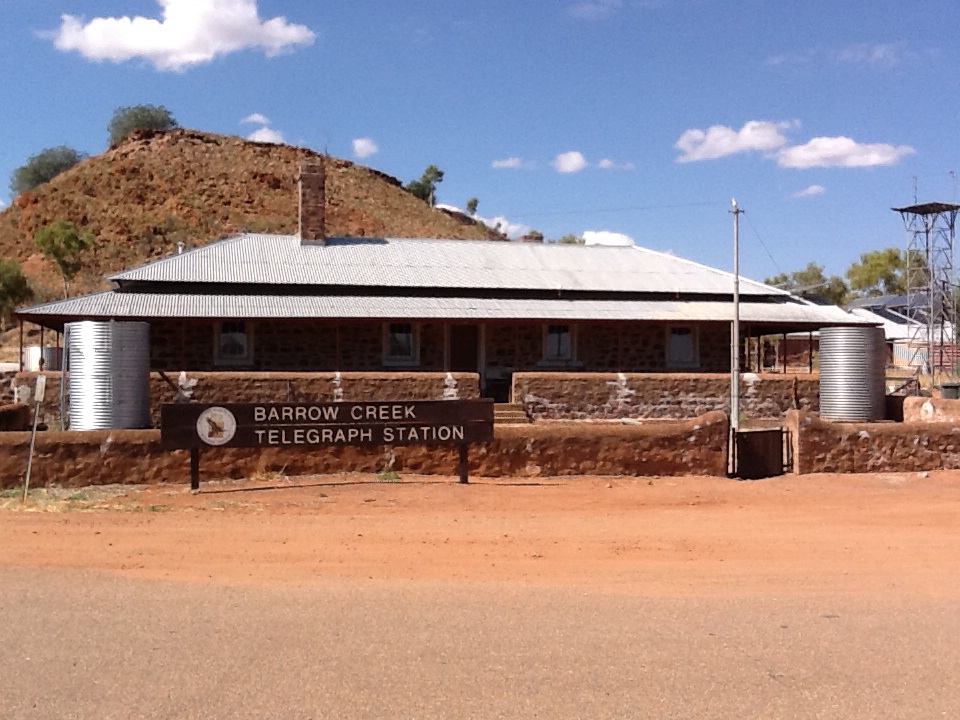
Telegraph Station at Barrow Creek

Telegraph Station at Barrow Creek

We stop at Barrow Creek where tensions between settlers and the local indigenous people have exploded over the years, with murderous consequences. In the late nineteenth century, two white settlers manning the telegraph station were killed by an aboriginal group. It is believed this was in response to fencing off a major waterhole. In reprisal, ninety men, women and children were slaughtered. Later, in 1928, a white dingo trapper was murdered. The local police carried out a bloody series of reprisals, resulting in the deaths of around 70 people. The Coniston Massacre, as this infamous event is known, was the last major massacre of aboriginal people in Australian history.

The dark spirits woken by these murders have not yet been put to rest. In 2001 Peter Falconio lost his life on the stretch of road just north of here. His body has never been found.

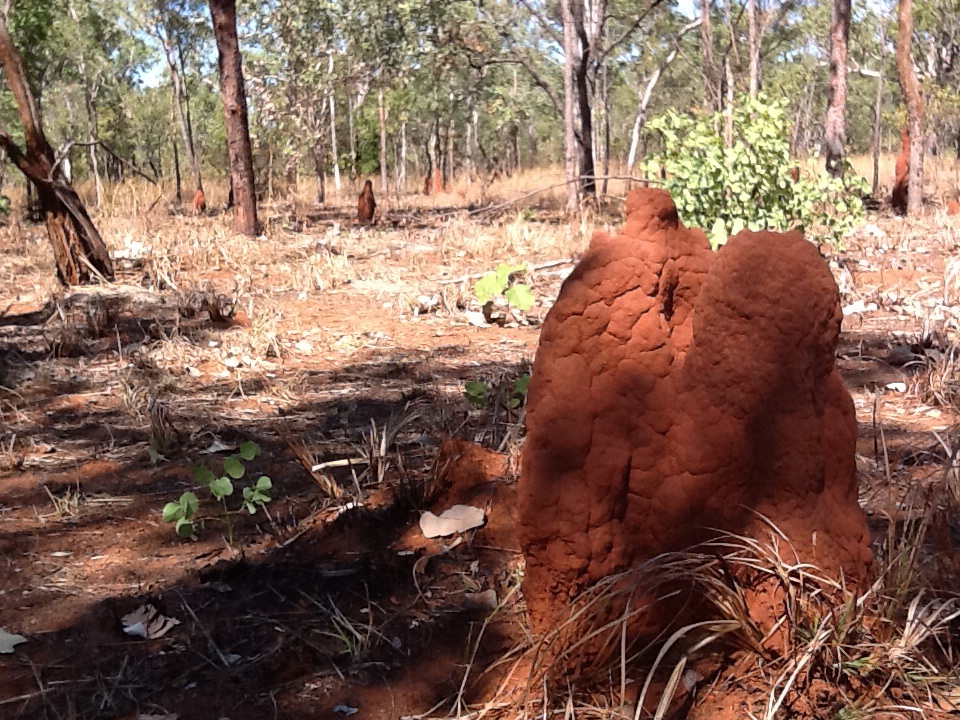
Termite mound

Termite mound

I gaze out of the window. The alien shapes of termite mounds dotted between the trees look like Neolithic standing stones, cathedrals to an ancient religion.

The heat intensifies. The air conditioning in the car is working hard to little effect. We pull into the ancient aboriginal dreaming site, known in four different aboriginal languages as Karlu Karlu and to white Australia as the Devil’s Marbles. My head throbs.

Devils Marbles

Devils Marbles

I sit, leaning against the massive granite boulders while the others walk around the site.   Perspiration wets my skin, despite the shade.   I sense the rocks as a living entity, pulsing with earthly power.  There is power, but no malice here.  The rocks were formed through millions of years of erosion.  They have lived through many generations of human experience.   Their powers are beyond the comprehension of the new settlers in this land.   We are too civilised to understand.   But not too civilised to feel.

The rocks glow in the afternoon sun as we get back into our vehicles and head for the highway.

My head begins to clear as we pull away, but still the heat is unbearable.  We take a detour off the highway and find a bush camp by a small waterhole.   The water is so inviting, we clamber in for an evening swim.  Trees frame the banks and birdsong vies with the chirp of crickets and cicadas.   The cooling water washes away the unease I had felt during the day.  The heat of the day fades.

We relax around the campfire, eating a delicious camp oven meal cooked by Brett and Christine and turn in early to enjoy the peace of this tranquil camping spot.


A Town Called Alice

We fly along as rutted red clay tracks become wide, easy driving unsealed roads. A squadron of budgies swoops past to check us out as we rattle across a cattle grid, the white trunks of ghost gums bright against the clear blue sky in the distance.

We are on our way to a town called Alice. Phones ring out as we reconnect to the outside world. The landscape morphs again, soft green alternating with ochre stone in stripes undulating along the mountain range beside us. Black headed grasses sway in our slipstream.

The roads begin to buck and roll with the mountain ranges, turning our pleasant drive into a fairground roller coaster. I gasp as the ute flies into the dips and over the crests.

The Stuart Highway, the main route from Adelaide through Alice to Darwin, is the first bitumen sealed road surface we have driven on in a week. Culture shock hits us as we turn right on to the road. The Royal Flying Doctor Service Centre passes on the left, a solar power station on the right. We are back in civilisation. It’s not a good feeling. Fences and signs grate on the nerves after the wide open spaces of the desert. We lose our freedom, but gain the benefits of supermarket shopping, hot showers and counter meals.  Is it worth the trade?

The entry to Alice from the South is through the Heavitree Gap.  This is a natural gap in the Macdonnell Ranges that allows river, road and rail to pass through.  The imposing rock faces tower above as we squeeze through the opening and into Alice Springs.

We take the opportunity to stock up on groceries, savour a real coffee and listen to the owner of an indigenous music shop give a sample of throaty didgereedoo music. The shop’s sales of music sticks soar as money changes hands.   Everyone enjoys time to do their own thing.   I visit an indigenous art gallery.  Richard cleans the car from top to bottom, vacuuming out every last speck of red desert dust.

The art gallery has a huge selection of work.  Indigenous artists are painting in the studio behind the shop and the owner gives me a tour of the back room full of huge works, intended for corporate foyers or board rooms.   The variety and quality is impressive.  I am tempted by a cross hatched painting of men fishing in a canoe and a superb dot painting representing the dunes of the Simpson Desert.   I will try to find time to return when we come back to Alice later on in the trip.

We overnight in the Heavitree Caravan Park, just outside the gap.   It is a pleasant shady camp site, but it is of course close to the road and rail through Alice.   The trains seem to go on and on and on as they rattle past early in the morning.   Leaving us all bleary eyed through lack of sleep.  It was not like this in the Simpson.

A certain competition has grown up over the last week.   Who can pack away their tent first?   It is not discussed, but furtive looks are cast across the campsite early in the morning.   At first light the sound of kettles boiling and tents creaking can be heard.   Every morning the camp is packed up earlier and earlier.   Hoarse whispers are heard, “What time is it?”.   “Brett’s packed away already, I don’t believe it”.   The experienced crew start to get twitchy.  “Relax, we’ve got plenty of time”.   Of course it easy for them, the pop top campers flick away in seconds, leaving their owners to sit relaxing with a cuppa, watching the antics around them.  I’m sure we can trim a few more minutes off our pack up time, but it is already down to a fine art.

At 8 o’clock we head off north on the Stuart Highway.   Ready for stage two of our red centre adventure.