Tag Archives: Australia

The adventure begins

The alarm rang out at 5:30 am. It was an early start. We rushed through the last few tasks on the “Do Not Forget” list, left a list of phone numbers for our house sitter and loaded up the contents of the fridge in the back of the ute. I fumbled with the keys as we locked up the house. At last, at 7 am we were on our way.

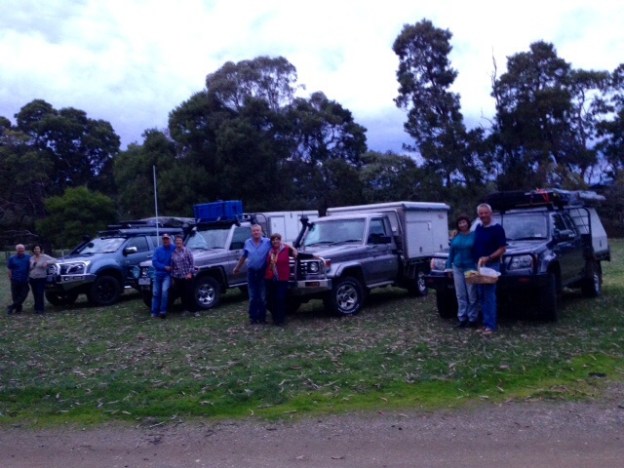
Three utes were already parked together on the driveway when we pulled up. We were the last to arrive. Everyone was milling around laughing. This is Deans Marsh and I should not have been surprised to see that we were not allowed to slip away quietly without a sound.

Our friends, Dom and Suzanne had dragged themselves out of their warm bed to see us off. Dom handed out an eclectic survival package of essentials to each couple (shower cap, chocolate, elastic bands, fly strip, etc), while Suzanne in her pyjamas, dressing gown and slippers pressed a fresh persimmon and lime from their garden into our hands. “Lime for the Margaritas and a persimmon for your morning tea,” she whispered.

image

We all stood by our cars for a formal photo, said our last goodbyes and we were off.   “Channel 16”, called Olive as we pulled out of the gateway.  UHF radios were switched on and we carried out our first radio checks.   Howard and Beryl naturally took the lead, while Malcolm and Olive waited until Brett and Christine, Richard and I had followed before bringing up the rear.  It was if the old hands were gently herding us along the way.

We headed out through Colac and Camperdown, taking the road West.   At Mortlake, nearing the Grampians, I turned to Richard, “Do you know, this the furthest West I have ever been on the continent of Australia?  Better not tell Brett, he’s from West Australia, he won’t believe it!”

I’m slightly ashamed to admit that although I have travelled up the East Coast of Australia, I have never visited Perth in the West, or even Adelaide, the state capital of South Australia.  Everywhere we go from now on will be a totally new experience for me.

Along the way I marvelled at the Aussie town names.  Who came up with a name like Willalooka? A township with timeless stone buildings turned out to be called Hexham, named after a well known Northumberland village, who knows why?

Every town along the way celebrates or remembers something, the national collection of eucalypts, the Ansett museum, the famous Dergholm guinea flower.     Even the smallest town has something unique about it, some small source of civic pride.  In Coonalbryn, it is a roadside Belgian Waffle stall, selling authentic waffles made the way they make them back home in Liege. Beryl chatted for a while to the Belgian stallholder learning when and how he came to be a Belgian selling waffles in a small town in Australia.   Having made her contribution to Belgo-Australian relations, she then made her way back across the busy road with a plate loaded high with waffles, strawberries and cream. The waffles were soon devoured and I believe they were deemed worthy of both Belgian and Coonalbryn pride.

There were many large stations farming this country in the early days of settlement.  Along the way, we spotted an old Western District homestead that had been rebuilt for tourists and was well worth a visit on another trip.  “They even have their own lock up prison cell there”, called out Olive on the radio.   “They needed to have somewhere to put the farmhands when they got out of control”.   “You’d better get Malcolm to build you one at home”, came the quick reply.

The countryside was green and lush as we drove through Western Victoria and it was easy to see why this has always been prime cattle and sheep country.   As we drove into South Australia, the land grew flatter.  Vineyards stretched as far as the eye could see, their golden brown autumn colours muted in the afternoon light.

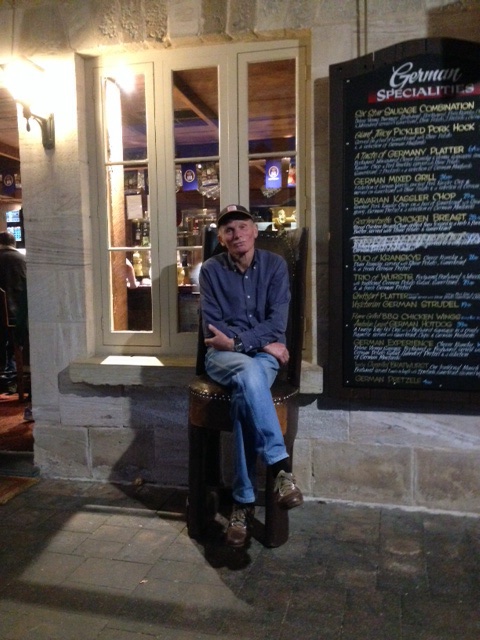
Finally, the flat land gave way to the beautiful rolling Adelaide hills and we drove into the busy town of Hahndorf, the oldest German settlement in Australia.   Hahndorf makes the most of its German origins with Apfelstrudel, Bratwurst and Weizenbier all on offer.   It’s easy to see why the town is so busy with tourists on a warm Autumn weekend.
image

We drove almost 700 km today, taking the best part of 9 hours to reach Hahndorf.   It was a long day and it is now drawing to a close.  As I write this post for you, dear reader, it helps me to reflect on the day and what will I take from it.   Today, passing through all those small, proud towns, it reminds me how it is truly human nature to love the place you live, to find something grand and memorable in it – something to celebrate with each other and with travellers passing through.

Ready, set…..getting ready to go

The night was cold, wet and windy. The rain lashed down outside the cosy farm house, and we agreed it was surely time to escape the Otways winter for the dry and dusty red centre.

With two weeks to go, the ten travellers in our convoy met for a pre-trip planning session. Most of the group knew each other already, a few introductions were made and we got down to the important business of eating, drinking and trip talking.

Three couples are experienced outback travellers, Howard and Beryl, Malcolm and Olive, Max and Heather.  Between them they have travelled many thousands of kilometres across Australia and have had their share of mechanical breakdowns, tyre blowouts, snakes, dingoes, rain, wind and everything else the Red Centre can throw at them.  But they still keep going back for more.

The innocents abroad … I mean the less experienced pairs are Brett and Christine, who have been camping with their family for many years, but not four wheel driving in remote locations, and of course Richard and me.  Well, I’ll be honest, we are the newbies who ask the naive questions!  Especially me… I’ve not done a lot of camping and this will be the first time I have left the safety of the urbanised East Coast of Australia for the outback.

As we tucked into the warming vegetable soup, followed by Beryl’s sausage rolls with Jenny’s amazing tomato sauce, questions and answers mixed with tall stories around the dinner table.

“What do you do about washing your clothes out there? Are there laundry facilities at the camping spots?”

“Yes, in some. The rest of the time just jiggle your undies in a bucket of water and you’ll be fine. We’ll all smell the same by the end of the desert trip.”

“Does anyone know how to fold away the pop up camping shower cubicle?”

We were glad to hear Christine has mastered this feat of manual dexterity.

“Do people really sit on top of the Big Red sand dune (the biggest in the Simpson Desert) with drinks and snacks to watch beginners try to make their way up?”

“Yes, it’s entertainment for the locals, but don’t worry, you’ll have no problem getting up there.”

Some answers were comforting, others less so.  We began to feel our inexperience quite intensely.

After dinner, Howard unrolled the map of Australia and the group gathered around to trace the route we would follow from the South to the North of this massive continent.

The start and end dates are fixed.  Our leaving date, 17 May, is non-negotiable and was set many months ago.  We will leave as soon as Howard’s bulls are put in with the females for their allotted nine weeks a year.   This momentous event happens at the same time each year, mid May.   This is a little later than our own Limousin bulls, Stan and Galli, who wait patiently each year for Anzac Day for the same reason and who are already wooing and cooing their way around our paddocks.   I love the fact that we are planning our trip around the farming calendar.   That’s life in the country!

The target destination is Adelaide River.   We plan to be there for the Adelaide River Races on 31 May, another immovable date.   (An outback horse racing meet will be a first for me.) But wait, you may be thinking that Adelaide is on the South coast of Australia?   That’s true, Adelaide is a Southern city, but Adelaide River where we are heading is actually close to Darwin on the North coast.

So we have 13 days to travel approximately 4000 kilometres, including the Birdsville Track and the Simpson Desert.   This gives us some contingency, but essentially we will have to be on the road, making good progress to the North every day.

After the races, the convoy breaks up and we go our separate ways.   Howard and Beryl will stay up North and drive through the Gulf across to Queensland.   Olive and Malcolm will tag along with them.  Max and Heather are at the start of a longer trip and will return to Birdsville to pick up their caravan before heading back North with the creature comforts a caravan can offer.   It’s not practical to take the caravan across the Simpson so they are leaving it in a secure location there on our way up.   Brett and Christine have commitments back at home that mean they will most probably have to take the quickest route South.

I have never seen the iconic Uluru (Ayers Rock) so we will be taking a detour to the West from Alice Springs to visit Kings Canyon and the Rock before we head home.

We all talk through our plans and finally as the group breaks up we agree to meet at 7am on Saturday 17 May to head off on our adventure.

I will update the blog as often as I can along the way so that you, dear reader, can come along with us and share our Red Centre experience – at least virtually!


Tea with Howard

When Howard talks about the desert, he shifts sideways slightly in his seat and looks out into the distance.  It is as if he leaves the room where we are talking and is immersed for a few moments in the sights and sounds of the remote Australian outback.

We are sitting around the kitchen table in his comfortable Victorian farm house.    Two empty tea cups stand to one side. Spread out on the table is a huge laminated map of Australia. He is pointing out the route we and eight others will take in two weeks time, and as his fingers pass over the names on the map he frequently pauses to tell me more about the places the names represent.

Howard is a very experienced outback traveller.   His first trip to the desert was in 1989 when he was in his early thirties.   He and another local man decided to take off to see the Red Centre of Australia.   He admits he was very green at the time and had hardly been outside of Victoria. He was totally unprepared for the vastness of the country he was to travel and the impact it would have on him. He’s traveled back many times since, crisscrossing the interior of Australia in his four wheel drive.

I’m left with the impression that Howard fell in love on that trip, in love with with the remote desert spaces in the centre of Australia.

His fingers trace our route from Deans Marsh to Hahndorf, our first stop. Then North to Peterborough and on to Marree where we will take the renowned Birdsville Track. Turning left at Birdsville, we will head for Poeppel Corner where three Australian state lines meet.

“It’s possible to stand with your left leg in the Northern Territory, your right leg in Queensland and you arms stretched out into South Australia.” Howard chuckles, “I once stretched out flat on top of the post there to do just that!”

“The spot was named after the bloke who first surveyed the area to pinpoint its exact location. It was way back in the late nineteenth century and he had camels drag a post and measuring chain all the way from Birdsville. When it was surveyed again, they found he was a few hundred metres out, and that’s because the steel linked chain had stretched along the way.”

Every place out here has a story.

Simpson map

Poeppel Corner and the Simpson

Howard pauses, and then almost reverently says “And here’s the Simpson.” He stretches out his hand and covers first the desert and then our home state of Victoria. “Look, it’s as big as Victoria, and there’s not a soul living in it.” Later I Google this to see if it’s really true. I find that the Simpson Desert official area is about two thirds that of Victoria, but if you add in the surrounding area that is informally included when people talk of the Simpson, Howard is right. The Simpson is about the size of Victoria!

For overseas readers, let me help you imagine what this means so that you can visualise the scale of this desert. It is officially 145,000 km sq (56,000 sq mi). That’s bigger than the whole of England, which is only 130,000 km sq (50,000 sq mi). Imagine then that no one lives in the Simpson (although some indigenous folk live around the periphery), while England has 63 million inhabitants.

Courtesy of NT Tourism

Simpson Desert – Courtesy of NT Tourism

I ask if we will see many other vehicles when we are crossing the Simpson? “Last time I crossed it I saw about 12 other vehicles over 4 days. That was 13 years ago, so it will be a lot busier now. We will probably see 3 or 4 times more. It’s busiest in the winter months of June to September, especially in Australian school holidays, but we are early in the season, so it will be reasonably quiet.” This sounds like a massive understatement for one of the most remote places on earth, but I know what he means.

We are crossing the Simpson East to West on the French Line, a track created by a French oil company in the sixties to open up the desert for prospecting. Fortunately no economical mineral deposits were found and the desert was left in peace, but with an access road used by many 4WD explorers today.

Howard points out the waypoints from the French Line on the way to Alice Springs, where we will join the Stuart Highway, passing through Mount Dare and Old Andado. Every place has a story, but this is already a long post!

Once we reach Alice Springs and the highway, the stories peter out and with a swoosh of the hand Howard indicates that the remaining 1390 km to Adelaide River will be a straightforward couple of days highway driving.

Up the highway from Alice

Up the highway from Alice

To an English ex pat the distances are mind boggling. Overall we will be driving around 4000 km in 13 days. That’s the equivalent to driving from London to the North Pole or New York to Calgary. It’s a hell of a long way, but this is Australia. Long distances are shrugged off with a larrikin smile and a wink. No worries, mate.


Your chariot awaits…

When you are planning a long trip into the outback, your vehicle takes on a new and heightened significance. It needs to be tough enough to cope with all kinds of terrain, from smooth freeway driving to scaling 35 metre high sand dunes.  It needs to be comfortable enough for you and your beloved to happily spend many an hour on the road, and most important of all, it becomes your home. It carries your food, water, cooking equipment, bed, clothes, first aid and rescue equipment.

IMG_0467

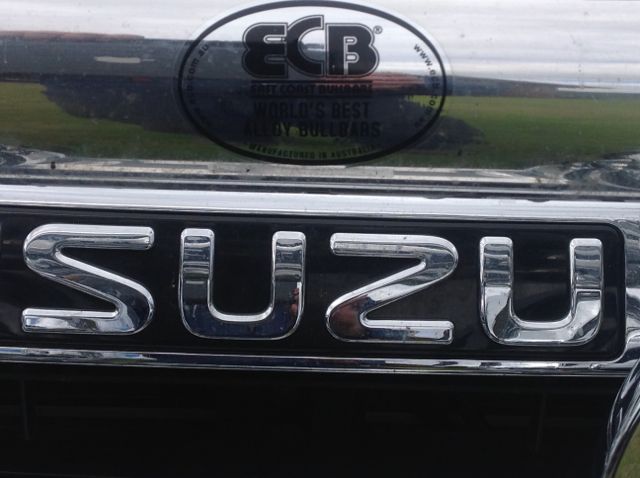
We bought our ISUZU ute last year as our runaround vehicle – chosen for its comfort, fuel economy and large tray (for dog transport and shifting garden supplies).  A secondary consideration was its 4WD capability.  As long as it could safely be taken on to the farm and out on to the unsealed tracks around the Otways, it would do fine.  But for the desert?

It is interesting how many different views are held on what is needed for a trip like this. We’ve heard all sorts of different opinions expressed with equal vigour and certainty.

There are those who adopt the famous Aussie “She’ll be right” approach and believe a basic 4×4 road car will be fine in the desert.  Then there are the brand worshippers.  We recently watched a 4WD TV show where the local guide, a Landcruiser man through and through, stated there is no point in undertaking any serious outback trip unless a Toyota is involved. Fortunately we will have three of these tried and trusted vehicles in convoy with us.  We hope our Isuzu D-Max will hold her head high in such esteemed company.

IMG_0464

Taking all these views on board, in the end we have done what we think is right. Only time will tell if we have made the right calls.  With the most remote and challenging part of the trip in mind, we have invested in some new features for our ute.

1) A long distance fuel tank – there are sections of our route where there are no opportunities to buy fuel

2) A dual battery system – this means we can run auxiliary power from a separate battery for our “home” needs, such as the fridge, keeping the main battery charged up for its primary purpose

3) Enhanced suspension – to give us greater clearance and robustness to cope with sandy terrain

IMG_0466

4) A bull bar – there be camels and roos out there…

5) A UHF radio and antenna – to keep in touch with our convoy and find out what those road trains are planning.

IMG_0465

6) Extra spare wheels and tough looking tyres, called Mickey Thompsons – to provide more grip and resilience for the outback conditions and spares in case of trouble

IMG_0468

As a result, the ute has grown, both in height and length and now looks a little imposing in the local shopping centre car park!  We think it is ready..


Link

“Tracks” is now a movie

The book Tracks has been made into a movie.  I haven’t seen it yet, but I will try to before we go.

Here’s a link to an interview in The Guardian with Mia Wasikowska who plays the lead role as Robyn Davidson.   Robyn comes across as a formidable young woman in the book, so it must have been daunting for Mia to meet her when making the film.  It sounds as if Robyn has mellowed a little with age as she admits Mia does a reasonable job at acting as her twenty four year old self – despite having her doubts when they first met.

The photography in the movie is said to be stunning, so if you’re interested in what the big red bit looks like, it could be for you.  I suspect the desert is the real star in this one.

Have you seen it?  What did you think?

Home is where the heart is…

I’m lucky. I truly love the small piece of this planet we call home. I’m one of those people who wakes up in the morning, opens my bleary eyes and sighs in pleasure when I realise I am at home, here in the place I love best – our farm in the Otways. When I am not here, I take this place with me, tucked away in the back of my mind as a touchstone when I need to be reassured. I can close my eyes any time and hear the song of our birds, the warbling magpie, chuckling Kookaburra and excitable peeping fairy wren. I can conjure up the scent of the forest, the minty gum leaves, the musky layers of the forest floor and the misty Otways air.

And yet… I hear the call of distant climes. I am drawn to the travel pages in the Weekend Age. I love reading about people who have ventured out into the four corners of our beautiful planet. Ten Years in Tibet cuddles up to Under The Tuscan Sun on my bookshelf. My DVD collection is heavily weighted towards travel, from Michael Palin to David Adams, Rick Stein to Jamie Oliver, Ewan MacGregor to .. well, Charley Boorman. I like to tag along with them all when they are out there exploring the sights, sounds, smells and tastes of the great unknown.

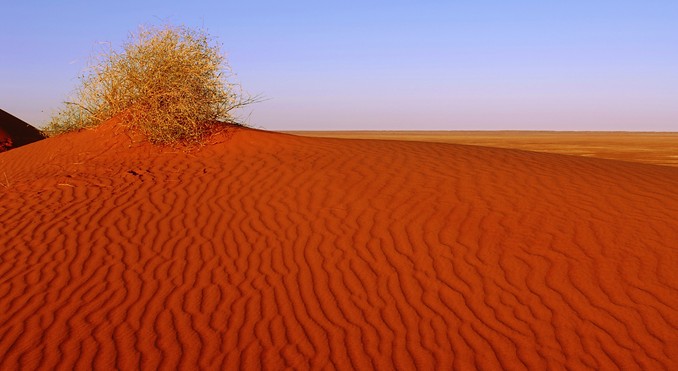
In three weeks time we will drive out of our farm gate, in our newly equipped vehicle, carrying our home on our backs, or at least our tent on the rooftop of the 4WD, and will be on our way across this massive continent. I will feel such mixed emotions as we drive down our unsealed road and meet the highway. How hard it is to say goodbye to this place, it tears at my heart. But how exciting, what a thrill to be on our way to the red centre. How I’ve longed to see for myself the great expanses in the interior of this sunburnt country. I imagine a landscape like I’ve never seen before, can it really be that colour? Can this country really be so huge that we can drive for 2 weeks without reaching the North coast? I have to see for myself.

Am I the only traveller who feels torn? Home is where the heart is, but out there lies excitement and adventure, the unknown, and we are drawn inevitably to explore.

My bedside table

My bedside table

“All journeys have secret destinations of which the traveler is unaware.”
  Martin Buber

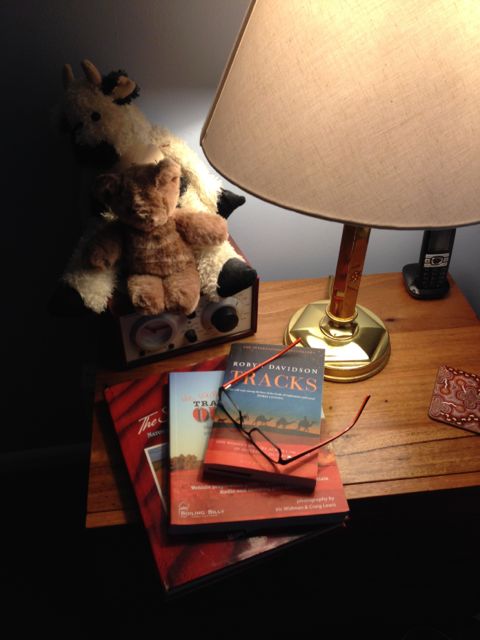
On my bedside table I have three books.  The three book covers hint at a common theme.  Colour? Red, red and red.

I am preparing myself mentally for a journey into the “Big Red Bit” in the centre of Australia.  I will not be alone, unlike the intrepid Robyn Davidson in “Tracks”, the book on the top of the pile.   Robyn travelled across 1700 miles of Australian outback with only three camels and a dog for company.   I admire her.  Being somewhat less intrepid myself, I will have my husband Richard with me, and for most of the trip we will be with a group of friends and neighbours from in and around Deans Marsh in the West of Victoria.   Robyn’s book has helped me with a few tips on how to break in a camel (could come in handy) and has conjured up something of what it is like to be in the red centre of Australia.  It’s not possible to sum up this landscape in a few easy words, says Robyn. “It is difficult to describe Australian desert ranges as their beauty is not just visual.  They have an awesome grandeur that can fill you with exaltation or dread, and usually a combination of both.” Wow! Awesome in the truest sense of that much maligned word.

The second book is Vic Widman’s “Travelling the Outback – the complete guide to planning and preparing for your outback adventure”.   It’s a very practical source of information on anything and everything you need to do to prepare for a trip.   The chapters on Camping Gear, Food & Water and Personal Needs have been particularly enlightening for me.   “There is really no need to do without anything on your camping holiday”, says Vic before covering showering and toilet facilities when travelling.   Important stuff indeed!  Richard has spent somewhat more time leafing through the Preparing The Vehicle section.  More about that in future posts.

The Simpson Desert is the most remote area we plan to visit and warrants a book to itself. Mark Shephard’s “The Simpson Desert – Natural History and Human Endeavour” is a real gem.   This is THE book on the Simpson desert. It is full of gorgeous, evocative photography and a wealth of detail on the history and nature of this unique part of Australia.   The dedication at the front of the book took me aback, it reads “To my son Matthew, who was fortunate to be able to experience the desert before he was one year old”.   That must have been quite a family holiday!

I can’t compete (and don’t intend to) with the illustrious writers of these books, but in a small way this blog will add to the literature describing travels into the Big Red Bit in the centre of Australia.   I hope it informs and entertains anyone who stumbles across it and is interested enough to spend some time reading here.

I liked the quote by Martin Buber that I’ve used as the title for this post.  I hope you do too.  It reminds me that no matter how well we plan for the journey, it will take on a life of its own and who knows what its secret destination may be.