Category Archives: Australia

Motel California

You can’t always rely on the Internet to find last minute accommodation. Trust me, I know.

The motel comes into view as we drive around the corner. Grass is growing between the cracks in the concrete. Paint is peeling from the faded sign.

I climb reluctantly out of the ute. Heart sinking. Foolish optimism making me hope that maybe first appearances are deceptive. I’ve booked the motel for the eight of us to stay overnight before taking the ferry across to Hamilton Island. I need to check it out.

A paper sign is stuck to the window with Sellotape, handwritten in black ink. “Call Dave on 0431 254 876”. I peer inside the darkened interior. A figure moves slowly towards the door. A middle aged man, dressed in baggy trousers and a stained cotton shirt pushes the sliding door open.

We’ve booked rooms, I say.

He mumbles. You’ll have to speak to Dave in room 5. Just knock on the door.

The door to room 5 is closed. The curtains are pulled over. I knock.

No response. Knock again, calls Beryl.

I knock again, louder. The door opens. I see a bed. The sheets and blankets are pulled to one side, pillows piled in the centre.

We’ve booked rooms, I say. At this point I’m contemplating my escape plan.

Dave, hair sticking to one side of his face, taps the side of his head.

Give me a minute to get my head together. Just give me a minute.

He closes the door, then quickly reopens it. His face confused.

You have to give me a minute to get my head together.

We’d like to see the rooms, I say. He fumbles in his pocket and drops a handful of keys into my hand. Look at 3, 5 or 6.

I look at the jumble of keys. I can see two with labels marked 3 and one with a label marked 9. Room 9 is nearby. I turn the key in the lock and look inside. The room is a mess of bed clothes, a mop and bucket stand by the door. I close the door quickly. No way are we staying here.

He said look at room 6, says Beryl. As I walk over to the door marked 6, I hear Howard call out. Lovely gardens you have here.

The small dirt area in front of the motel building is sunbaked. A few lonely weeds struggle to find life in the desolate strip of soil.

A strange noise is coming from room number 6. My feeling of foreboding increases. I walk towards the door. Hand ready to turn the handle, I stop and listen. Silence, except for the strains of a familiar song playing in my head. “Welcome to the Motel California, such a lovely place, such a lovely face…”

There is a key to room number 6, but the door opens as I turn the handle. Two beds. A view. It looks all right, says Beryl. Inwardly I admire her chirpy optimism. I wish I could share it.

The red counterpanes on the beds look old and tired. The carpet threadbare, well worn. Turning back the bedclothes I see biscuit crumbs.

A sound comes from the bathroom. I turn my head. A cloud covers the sun and the room darkens. I take one step forward. The door to the bathroom slowly opens. I step back in surprise as much as horror.

“There’s plenty of room at the Motel California, any time of year, you can find it here.”

I run quickly from the room and thrust the keys back into Dave’s hand. It’s not what we are looking for, I call, as we drive away.

What did you see? Asks Richard. I look out of the window at the figure of Dave receding in the distance. The doorman is just visible behind the smeared glass entrance door. A shiver runs down my back, I’ll never tell.

“You can check out any time you like. But you can never leave…”
Roma cattle sales

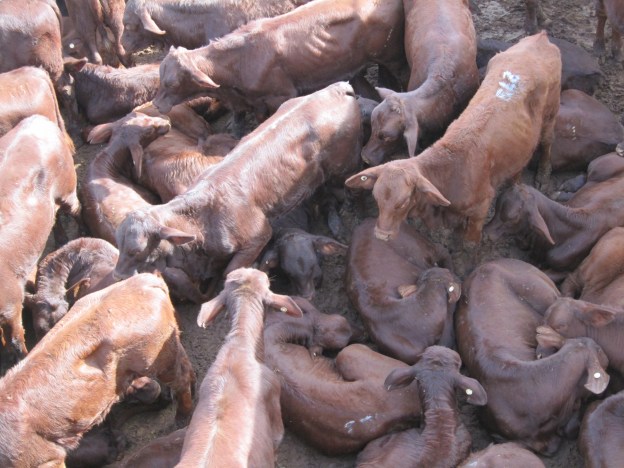
The markets at Roma are on a huge scale. About a million cattle pass through the sale yards and spelling pens each year. Today more than 8000 cattle will be sold.

I walk along the metal gantry above the yards where the cattle are penned. Angular steel pens stretch out into the distance. The smell of manure is sharp and sour. The calls of the cattle blare out. Their mix of tone and pitch like a ragged brass band tuning up before a gig.

Brahman

The animals are grouped together into lots for sale. I watch with interest a group of Brahmans, milky white with flop ears and hump. An unusual sight in Victoria, they are common in Queensland. A group of Herefords sniff through the rails at the unfamiliar cattle next door. A solitary Droughtmaster bull stands and stares. Most of the animals are remarkably calm, despite their strange surroundings.Roma hand sits it outl

The proceedings are carefully orchestrated for speed and efficiency.

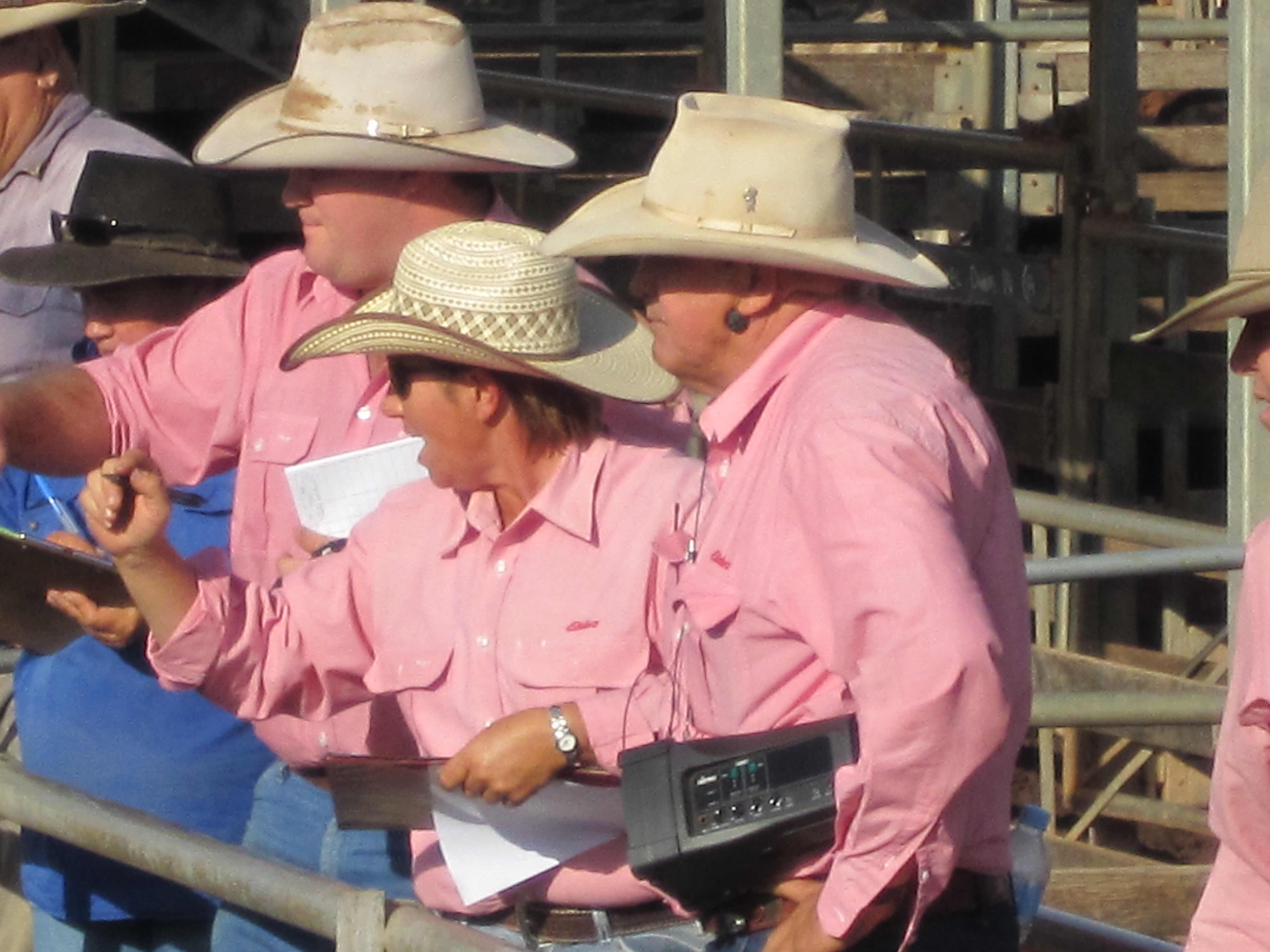
Sale yard officials are colour coded. Pink shirts are auctioneers. Spot them and you know where the action is. They jabber and gesture in an arcane ritual as unintelligible to the uninitiated as a witch doctor’s chant. As they move through the yards, a team of four, they conduct the movements in this agricultural dance.

Roma auctioneer

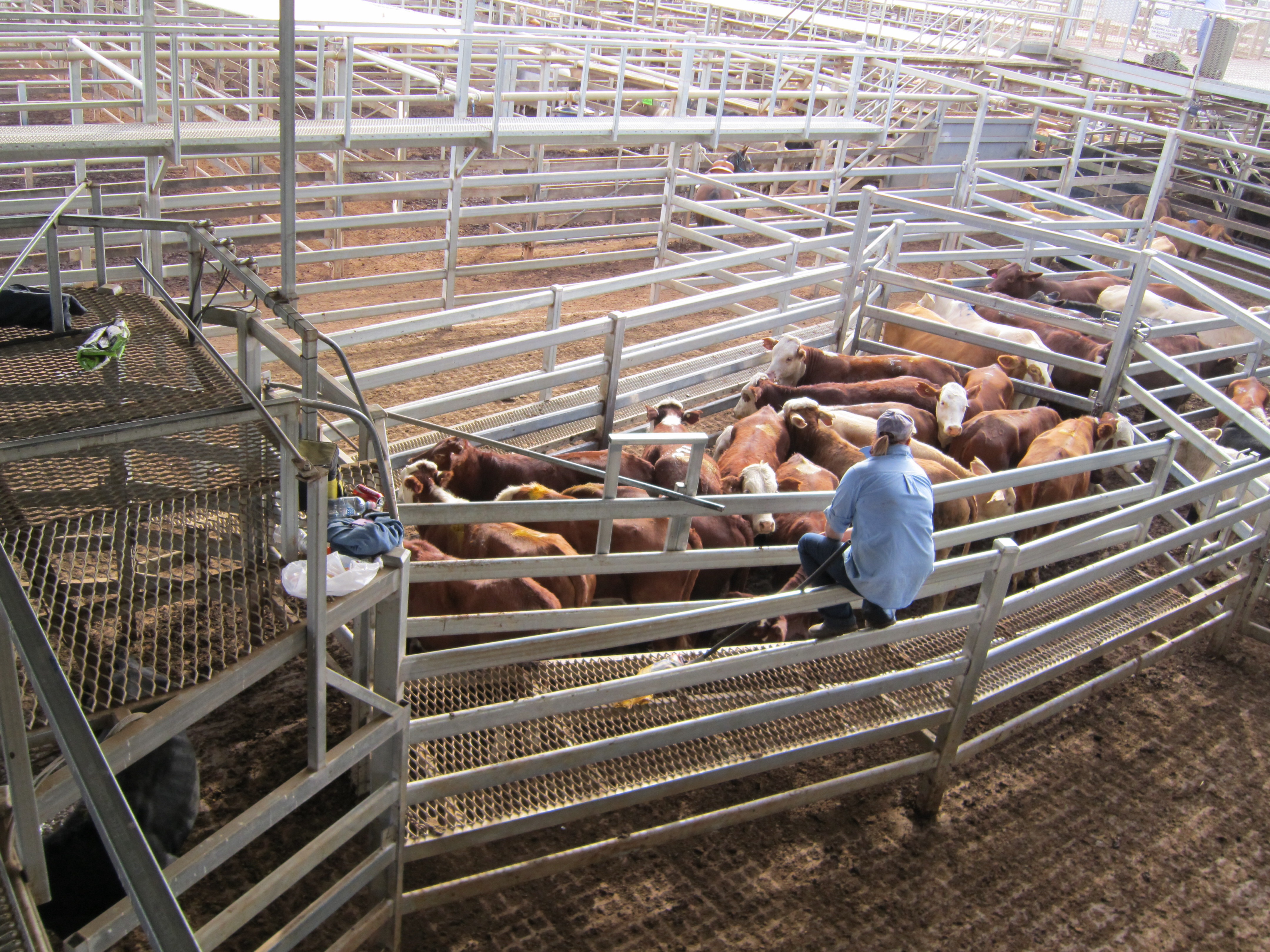
Blue shirts are yard hands, both men and women, driving the animals through the yards by waving old grain sacks on poly pipes. They stand on the overhead gantries above the cattle, waiting for the metal gates to open by remote control like lock gates letting the flow of animals through the system.

Roma yard

Buyers wear a mix of pastel coloured shirts, some checked some plain. They gather at ground level, moving from pen to pen to assess the quality of the stock for sale. An almost imperceptible nod or wink can buy a pen of thirty steers. To the untrained eye the buyers’ faces look impassive, their movements slow and cautious. A counterpoint to the frenzied pink shirted auctioneers.

Everyone wears a white akubra hat.

Snatches of conversation. “It’s been a patchy season.” “Good price for cows.” “Export market’s holding up.” “Prices are booming in the U.S.”

A yard hand named Fish stands and chats as we watch the sea of cattle move below us.

He’s worked at the sale yards for 35 years, starting when he was fifteen. They talked about selling them off a few years ago and there was an outcry, he says. They stay in the Shire’s hands, for now.

image

Its hard work but he loves it. Every market day the auctions run from 8am until 8pm. There are private sales using the yards and a significant business spelling cattle in the yards. There is always work to do and he knows the ways of the sale yards well. It’s a good life.

All roads lead to Roma

General Howard leads his troops out of the bush.  He’s smiling, “We’re four minutes early.”

We are on our way to Roma, home of the largest cattle sales in Australia.   The roadsides here are dotted with white fluffy cotton buds.  Cotton is cropped in the area and seedlings are breaking out of the paddocks to mix with grasses, gums and prickly pears.  A flock of bright lime green and red parrots swoops around us as the utes roll on.  Bright yellow sunflowers, more escapees from horticulture, nod as we go by. It’s a fine day in colourful Queensland.  Layers are stripped off as we moult our winter woollies.  Some go straight to shorts and tshirts while the more cautious start with slightly shorter 3/4 pants.

I blink and wipe my eyes.  No, it can’t be, that looks like a flock of bright yellow sheep.  Sure enough, here are more newly shorn sheep, happily grazing, oblivious of their lurid hue.  Yellow dyes have been added to their dip to mark out those who have been protected from ticks, lice and other parasites.  Any that have missed the dip can be easily spotted by the farmer. It’s logical, but it gives the view a surreal flavour as if we are waking from a morphine dream.

We are soon at St George and ready for morning cuppas.  St George is a gracious patrician town, wide roads, well maintained buildings, a John Deere franchise and a river frontage.   We can’t stop long to discover more this time.  It’s on to Roma and the cattle sales.

Even the scrub looks like parkland here.  Red red earth, grey green grassland dotted with trees.   Well nourished cattle wander in the shade.  We hope for a sighting of Major Mitchell’s cockatoo, a pink and yellow bird with a magnificent crest, named for Major Mitchell who explored this area in 1846.  In pictures he looks a rare beauty, (the bird, not the major) but he has not shown himself to us yet.

Lunch is at Surat.   An historic town on the Balonne river.   Bottle trees line the street, one appears to look back at us, the shape of an eye drawn in the markings in its bark.

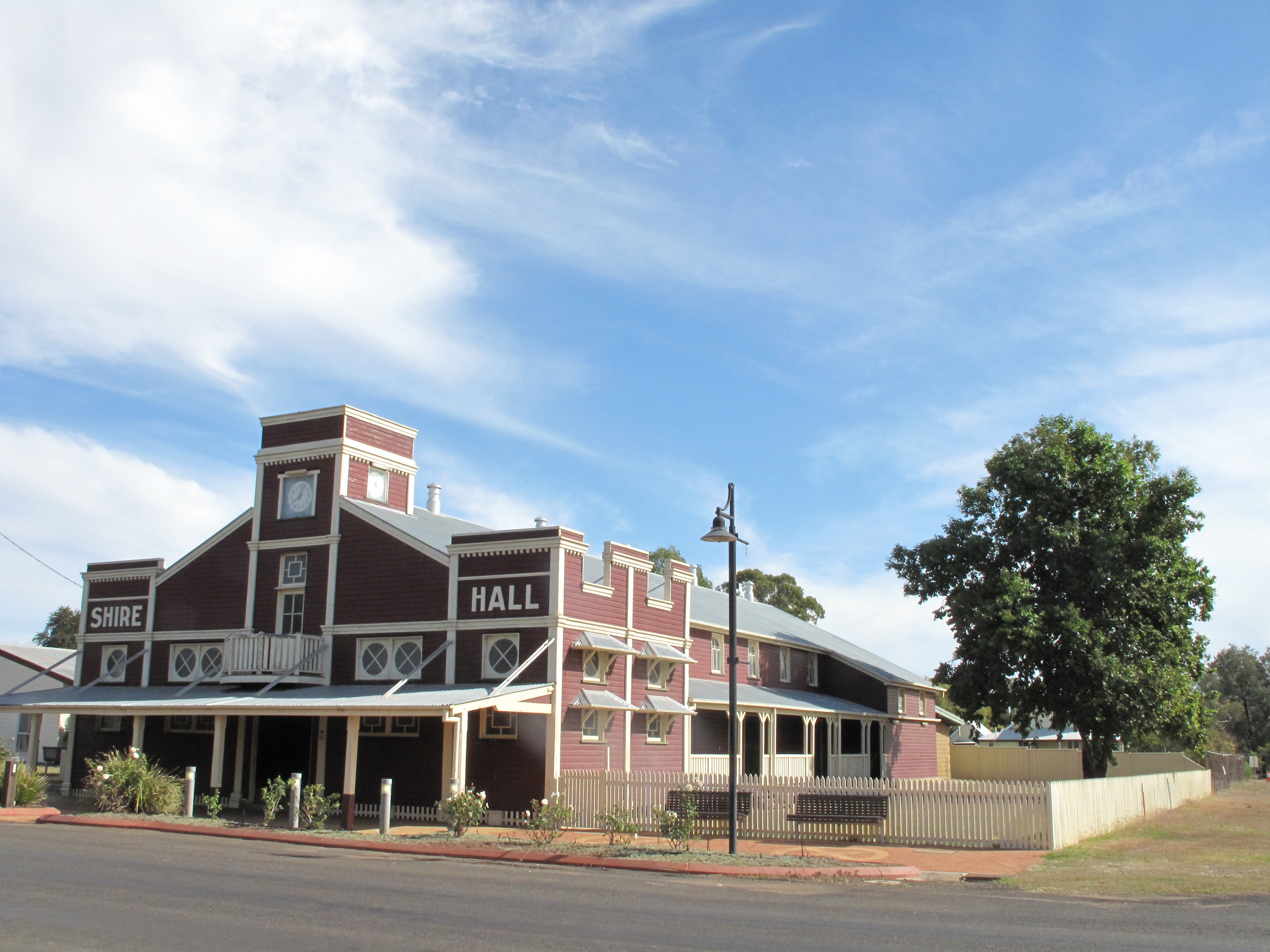
Eye in treeSurat shire hall

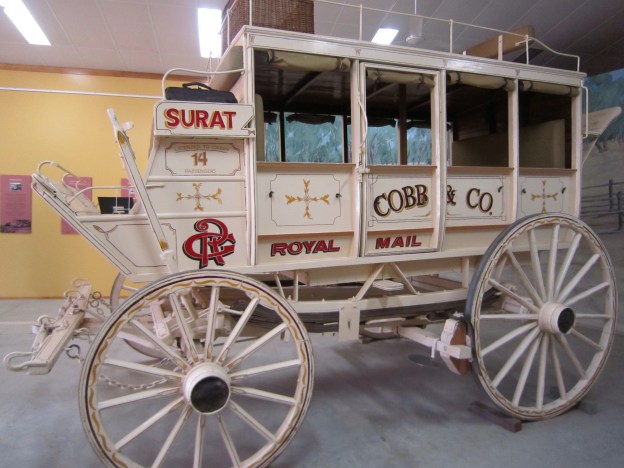
We admire the old timber buildings in Queenslander style, a post office, the magnificent old shire hall and a Cobb & Co changing station.  Inside a free museum on the Main Street there are old wool industry artefacts and the star of the show, a restored Cobb & Co carriage.

What must it have been like to speed down these roads in this wooden carriage, harnessing the power of seven horses, bouncing on the leather springs? No glass in the windows, no air conditioning to block out the climate, dust and scents of the outback.

These days it’s diesel-powered cattle trucks and road trains that drive through Surat’s Main Street.

We drive on. It’s not far from Surat to Roma. We soon see the signs for the cattle market and pull in to the sale yard car park.

Lightning Ridge

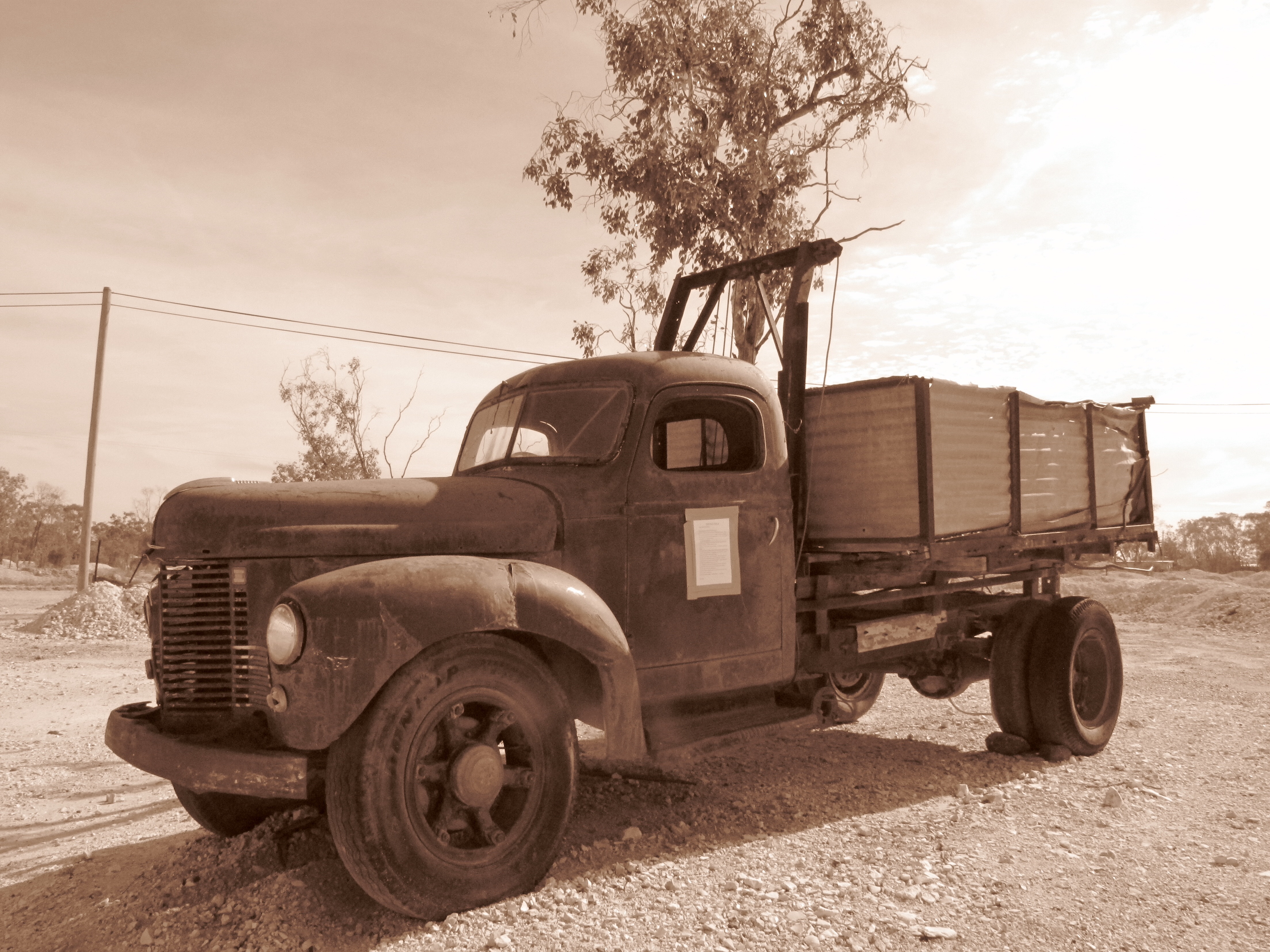
Lightning Ridge presents a more sanitised version of opal mining than we were shown in Bernie’s opal fields tour. The scent and taste of chalk dust remains.  There are just as many old Bedford trucks rusting the last days of their lives away here.  But in this town, the experience has been packaged for us.  We are guided by a map, with old car doors marking the way to the main tourist attractions.  Each “car door tour” is coloured.  The yellow tour marked with car doors painted yellow, and so on.   The tours take the sightseer around the town to take in all Lightning Ridge has to offer, and to spend some tourist dollars.

Lightning Ridge Truck

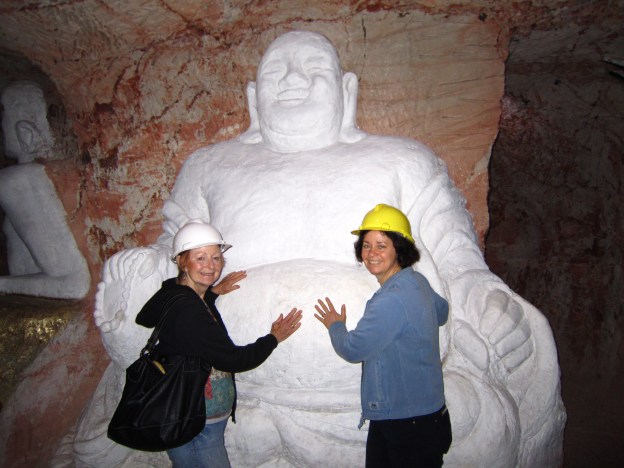
Those of us who had not visited before choose to visit the Chambers of the Black Hand.   A colourful name for an old worked opal mine that has been turned into an underground sculpture gallery.   Hard hats on, we descend into the depths.   Around the first corner we see indigenous animals carved into the wall.  Around the second we see Atlas holding the world on his shoulders.  Every section of the walls has been carved.  It’s an eclectic mix. Jesus and his twelve apostles sit at the Last Supper opposite a giant Buddha.   Ghandi is here and so are The Beatles.

Richard and Atlas Fab Four

The artist, an ex opal miner, has indulged his love of art and used it to make more money from his old opal mine than he ever made out of the opals he found there.   All cultures are represented, from Egyptian mummies to Spider-Man.  It is a remarkable feat and the gallery is fascinating to tour around.

The lower level of the mine has been kept as it was when he was still looking for opals.   We walk down into the depths to learn more about how the opal miner works the rock.  We peer into dark tunnels held up by tree trunks and listen to stories of the opal that was almost lost and of course the mythical opal millionaire.

Although my forefathers were Cornish tin miners, I feel a little claustrophobic as we wander further into the catacombs.   There is no doubt that the opal is a beautiful stone with colours from across the spectrum, but I make no purchase at the little shop at the end of our tour.   Heather spots some dainty earrings and after some expert haggling comes away with an excellent bargain.  Everyone is happy.

After Lightning Ridge we drive further north and across the border into Queensland.  Almost immediately it feels warmer.   “You can stop travelling now, you’re here”, says the shopkeeper at Hebel.  She’s a Queensland patriot.

This country is in drought.  We learn that there has been no real rain in four years.  10 mm in the last few days barely wets the dust and is not enough to break a drought.   Local industries are feeling the strain, and all they can do is eke out an existence until it rains.  Farmers have to choose between buying in feed for their stock or selling now and building up again when the rains come.  Some will go to the wall.

It is hard to predict drought.  Rainfall is a capricious creature.  It will drop more than 100mm in one area while leaving neighbouring towns bone dry.   While some parts of Queensland are flooded by typhoons, others wither away.   It takes a certain rugged resilience to hold out for four years without rain, ever hopeful that this month will be different.  This month the break will come.

It has not come yet for Hebel.