Category Archives: Outback

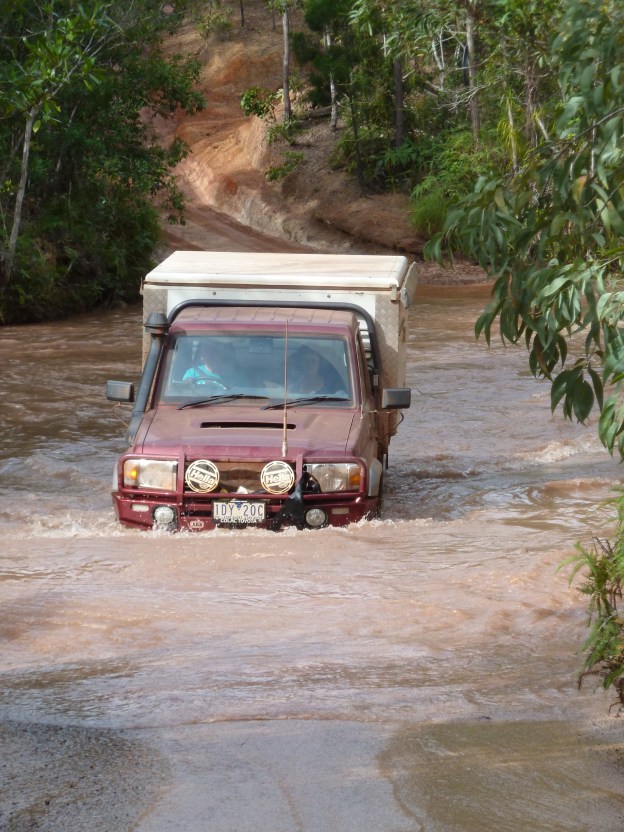
Creek crossing old telegraph track Cape york

  Driving on the Old Telegraph Track

We race down the Old Telegraph Track in convoy, five landcruisers one after the other, like rats down a water pipe.  Where the others go, we have to follow.  There is only one way, forward.

The track runs from south to north, up through the Cape York peninsula.   What was once the only route north to the topmost tip of Australia, is now a track for adventurers, for four wheel drivers who want to push themselves and their vehicles to their limits.

The already narrow track has deep water ruts. Our vehicles have to pick a route around the pot holes and widening cracks and crevices.   Trees crowd the roadway, leaning into view as we pass, scratching a message on the side of the camper.  It’s a bumpy ride, down into a hole here, up on a ridge there.

And soon we are at the next creek crossing. It’s Ducie Creek.   We stop to take a look at what lies ahead.  After Palm Creek, it doesn’t look so intimidating.  There’s a good flow of water running and we drive straight into it, then turn right along the creek, sending a bow wave ahead of us.  We take our time climbing the muddy channel up and out.  It is gouged with holes that make the ute dip and bow.  The cab rocks from side to side, but at least this time we keep all wheels on the ground.

Back on the track, red and green, red and green, the colours of the dusty road and the grasses and trees flash past us.  Crossing North Alice Creek poses no problems.  The entry ramp is steep, into the water and out.

Old Telegraph Track, Cape York Old Telegraph Track, Cape York

We follow the old metal telegraph poles along the track.  Many are bent, presumably by souvenir hunters reaching for the old insulators, looking for a piece of history to take home.

After lunch, it’s the big one…. Gunshot Creek.   It lives up to its formidable reputation.  Two deep gorges have been cut into the side of the creek.  The drop is almost vertical.   No one in their right mind would attempt to drive down there, yet recent tyre marks indicate some crazy fool has recently been this way.
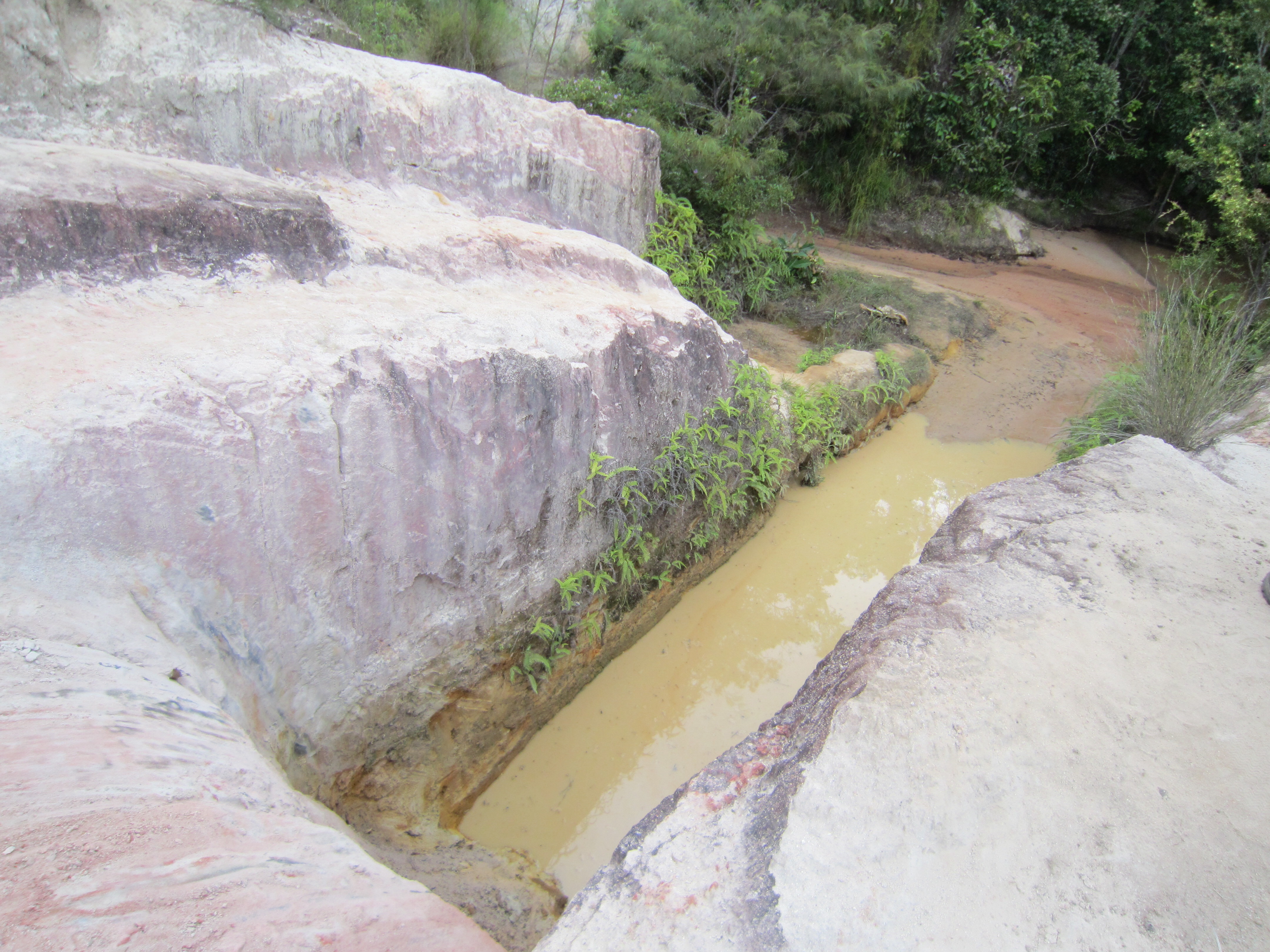
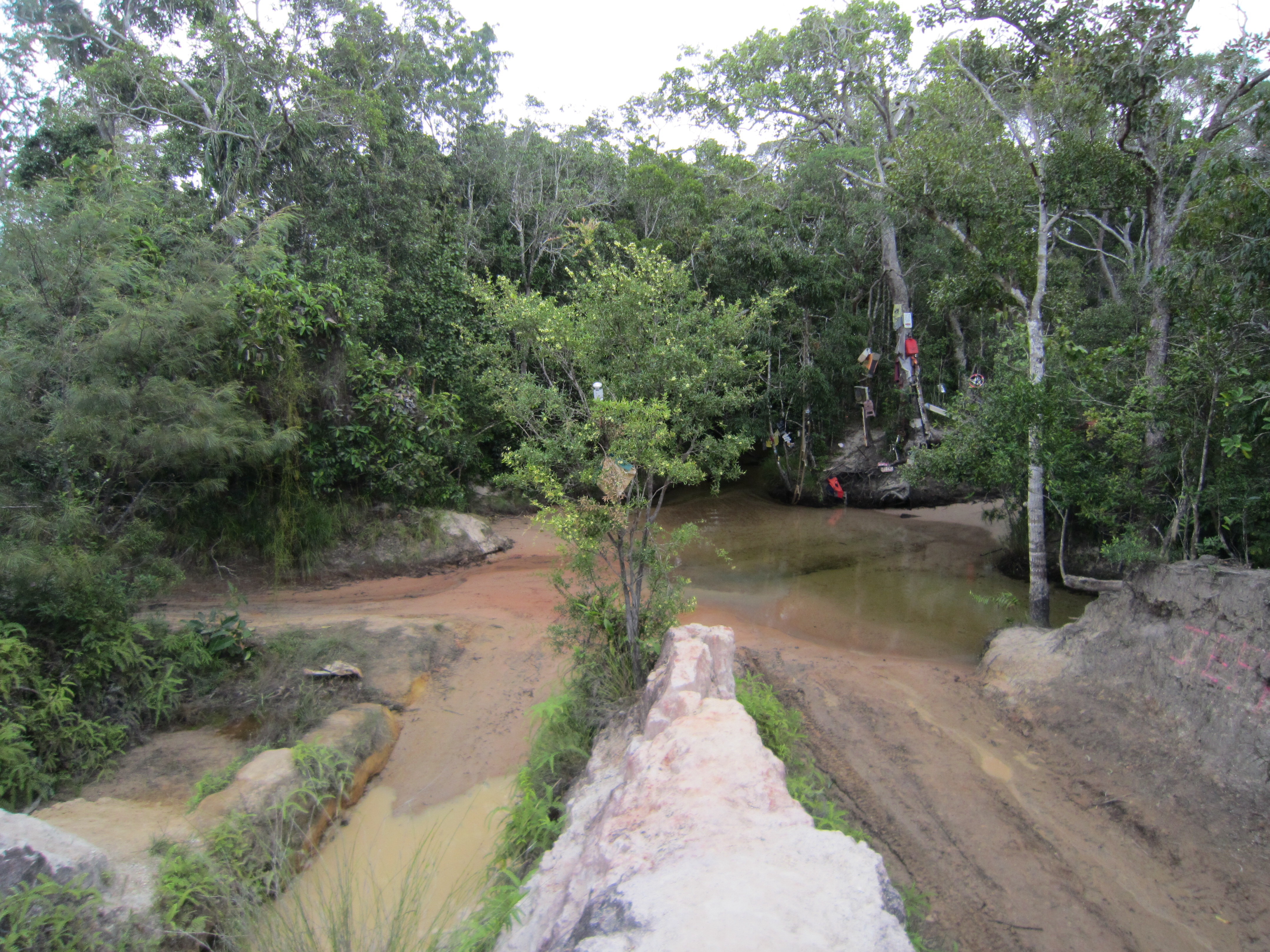
Gunshot Creek Old Telegraph Track Gunshot Creek Old Telegraph Track

I’m appalled by the destruction of the area around the creek crossing, the bare earth and vehicle debris hanging in the trees. 

A bright blue Ulysses butterfly flies by and disappears into the bush around us.

Scouting around for an alternative route we find the chicken run, a bypass that crosses the creek downstream.   This is challenging enough.  We drive across, then on into a rabbit warren track that takes us up away from the creeks and into beautiful heathland.  Like a garden it is vibrant with lush green growth and full of flowers after a recent burn off.  Golden grevilleas line the track.   Yellow flowers bloom.  I see a white flower with huge droopy petals in among the pink green grasses.

The track seems to follow a dry creek bed, or the course of a wash away formed in the wet.   It is a rough track, dusty and uneven.   The landcruiser is surefooted on its heavy off road tyres and takes every craggy ridge in its stride.

We stop for the night just off Cockatoo Creek.   A sign warns Achtung, crocodiles have been seen here.  That does not deter some of the group who strip off and paddle.
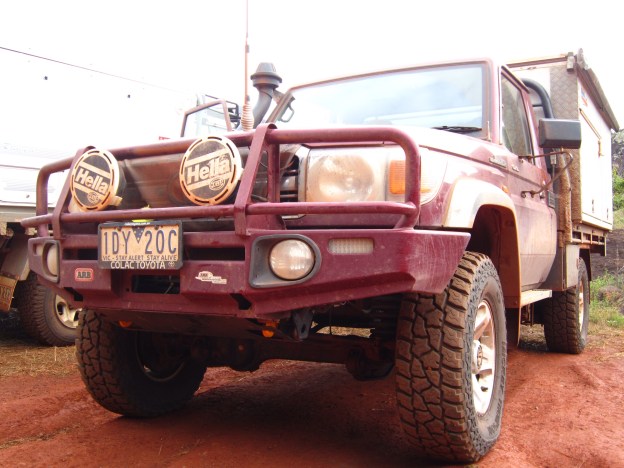
Landcruiser 4WD

OTT – a driver’s perspective

When the river crossings of the Old Telegraph Track are mentioned, there are hushed tones and furtive glances for 4 WD killers, Nolans Creek, The Gunshot.  I don’t recall Palm Creek hitting the headlines as a terroriser, but for our first intro to the OTT it got all our attention!

A small encampment of spectators have taken residence near the entrance.  I walk with the group to survey the route, a steep slippery mudslide into a dirty brown knee deep creek.  A 90 degree left turn then 90 degrees right to line up with the exit run.  I glance up the bank, a muddy rutted and washed out ramp about as high as a two storey suburban house.  My heart sinks.

I notice a battle scarred cruiser’s driver changing his tyre pressures.  “What are you using?”  “18 and 22”, he calls back and noticing my surprise adds “But only because I’m fully loaded, it would be lower otherwise”.  I sprint back and lower mine.  

Max is first to go, skidding down the approach, along the creek bed then gunning the big V8 until 10 m from the top.  The familiar sound of tyres spinning with no traction echoes around the creek

Not for the last time my Gemini twin asks “Why exactly are you doing this?” 

The electric winch whines and Max has reached the summit.

My turn arrives.  Low 3, I hear advised.  The cruiser slithers down the bank into the creek and I line up with the exit after a brief boat impression along the creek.

“Oh hell”, I utter as I see first hand the route I have to take.  “Hold on”.  And off we go, bucking and jumping, ascending with bone jarring leaps every few metres.  I hear a scream, followed by soft sobbing.  My passenger leans over, pats my arm comfortingly and says “Don’t worry, it’s nearly over.”

A last sickening thud and the windscreen fills with sky as the front rears up and over the lip of the escarpment, leaving terra firma briefly and all four wheels return to the ground well clear of the exit.

As a trainee pilot, I don’t remember a more a dramatic landing.

  I slide out of the driver’s seat my legs shaking, striding back to the exit and the clapping spectator who grins and advises that our side awning almost replaced his moustache as the cruiser made its final jump to the top.  I smile.  “No seriously, my son has it on video”.

“It’s awesome” he says “I swear you shaved the old man’s moustache and just missed that tree by millimetres.”  

I watch the video, the shaking of my legs returns.

Max strolls over, cigarette in hand and grins.  “We made it”.  I laugh nervously.  Max adds, “These cruisers go anywhere”.  He puffs his cigarette again.  “Next time though I think we should use 4WD.”

I hear his gravelly chuckle as he saunters back to his mount.
Written by Richard

 Old Telegraph Track

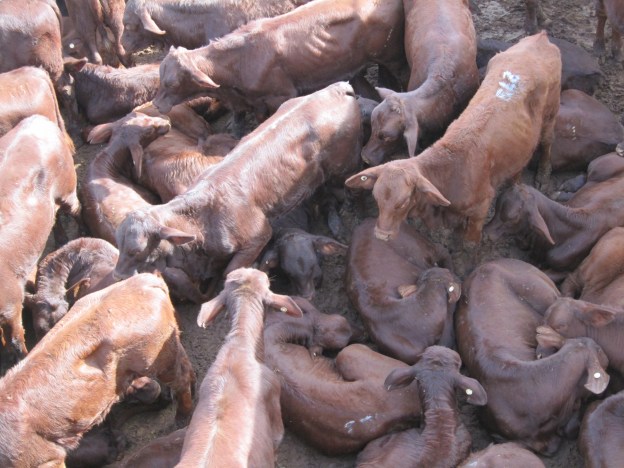
Bramwell Station is a day’s drive away from Pennefather River.   The campground has space, shade and good hot showers.   In the late afternoon, we watch the station hands sorting weaners from their mothers in the cattle yards next to the campsite.

It’s a big night at the station.  There’s a smorgasbord dinner, with barbecued steak and sausage, a table groaning with vegetables and salads and a sweet sticky toffee sponge dessert.  Music gets us up on the dance floor, winning a bottle of wine for the first to dance.   Who would have thought the singer would include the theme to Gilligan’s Island in his set?

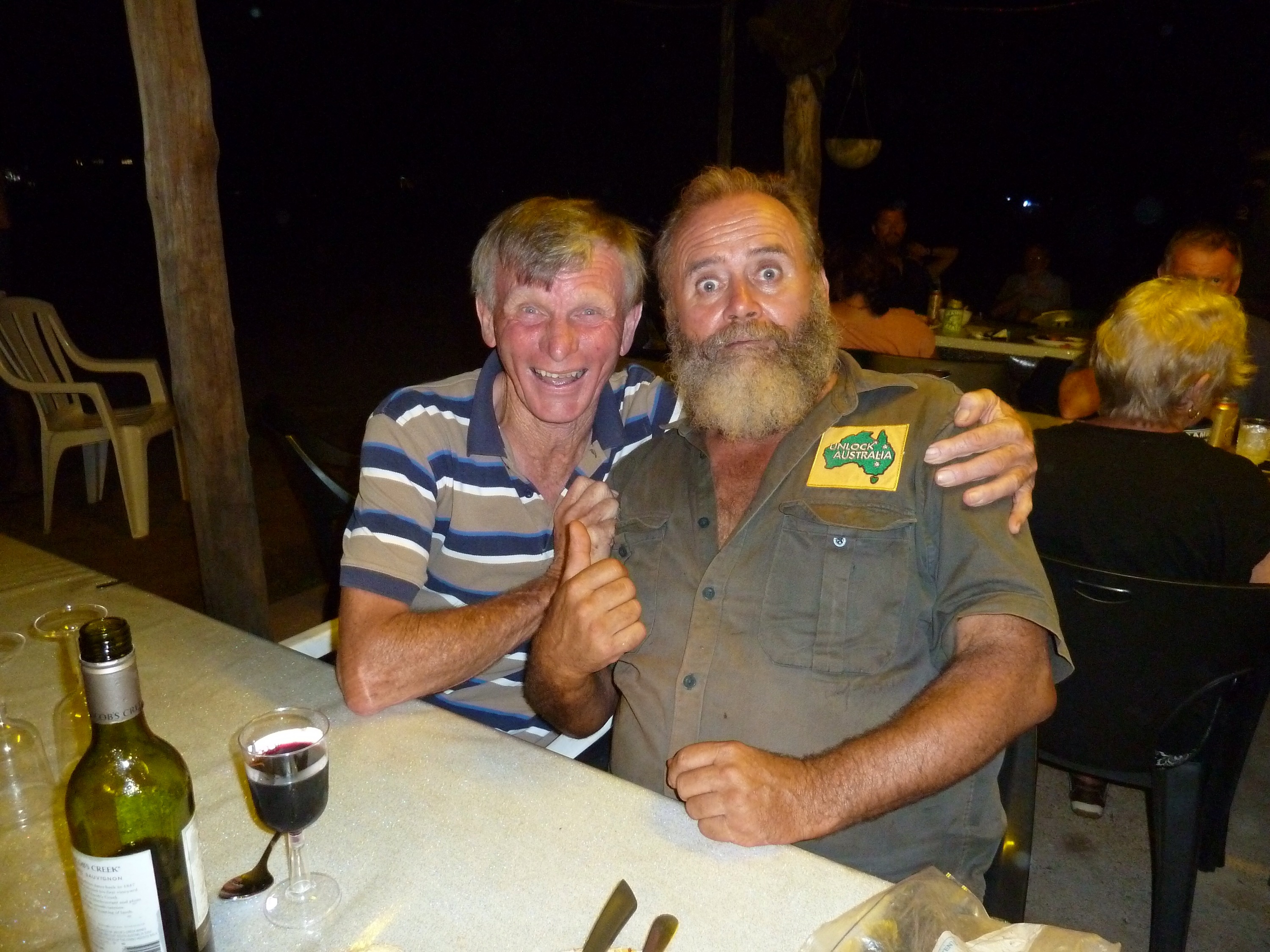
Malcolm and Roothie

A surprise guest at the dinner is Roothie, with his old Toyota Landcruiser, Milo.  He’s a four wheel drive legend and creates a buzz of excitement when he arrives with camera crew in tow.   Malcolm chats up Roothie, while his wife, Olive, makes a beeline for the handsome young camera man.

A high spot is the duet singing “Love Potion Number 9”.

The night is hot and steamy.  What sleep we grab is disturbed by the bellowing of the steers in the yard.    There’s a nervousness in the camp this morning.  Snatch straps are attached to the vehicles, just in case.  Today we are tackling the Old Telegraph Track.

Roothie and crew follow us out as we leave the campsite.  They are filming on the track today.

Old Telegraph Track

The track is narrow, tree lined, one car wide.  It is deeply potholed.   We soon arrive at Palm Creek, our first creek crossing.   A steep mud slide runs into a wet clay hole before levelling off into the creek.  The track runs through the creek to the left then up and out.

People are camped here, watching the attempts to cross.  “I wouldn’t take my tractor down there”, says Howard.  Cars are queueing behind us waiting to cross.

Max goes first.  Down the slide and to the left.   He tries to climb the steep exit out of the water and doesn’t make it.  He winches out.  Malcolm and Olive are through and then it’s our turn.

Richard is revved up, ready to go.  I’m gripping the door handle.   We scramble down the mud slide into the creek.  The ute rolls from side to side.  Richard turns the steering wheel left and we are driving up the creek.  The water is not too high, then the steep slope out is in front of us.   My heart pounds.  The engine revs climb and we shoot up the slope, rocking from side to side.

I can tell you, if I could have opened the door and got out, I would have done so there and then.   Christine, you would have had your eyes tightly closed.

I glimpse the track as we leave the creek behind us.  There’s a deep pot hole on one side and a huge lump of clay on the other.   The engine roars, one wheel drops into the hole and the ute twists sharply to one side.  We fly forward at an angle.  I can see only the sky.  Time slows down.  There’s a loud bang and we shoot out of the exit, landing on all four wheels.

Getting out, I look back at the vehicle.  It seems to be intact.   I hear later that our brand new ute missed a tree by a few inches.

I decide I’m not a fan of hard core four wheel driving.

The rest of the group make their way across without mishap.  Our Old Telegraph Track experience has started.

Inland to Bathurst Heads

It’s 10th June, Richard’s birthday.   We drive inland from Endeavour Falls along Battlecamp Road.   The red dirt is back.

The landscape has changed.  It’s the opposite to the rainforest.  The red roads gradually turn yellow as we drive through the low growing scrub and splash through the Normanby River creek crossing.

Old Laura homestead still stands.  A wide verandah tin and timber house, an old well, workers’ housing and the old forge remain.    The house is protected with chicken wire, to keep out tourists and perhaps the wildlife.  It must have been a hard existence living here in the heat, eking a living from the land.

Steel grey ant hills dot the country as we drive on from Laura.  This is national park land.  New regulations require all campsites to be prebooked online or by telephone.   This is bureaucracy at its best.   It’s totally impractical in an area with no mobile reception, public telephones or wifi.    It’s not in the spirit of bush camping to plan ahead and book the week in advance from Cooktown.   Plans have to change when a closed road, a vehicle repair or a fascinating side track delay the camper.   We shrug.  We will look outside the national park for our spot tonight.

The Kalpower River crossing is wide and flat, water tumbling down on the rocks below.  We drive on corrugated public roads through aboriginal freehold land.  The ant hills grow as tall as the scrubby trees.  Sculpted and impassive they look like druids’ standing stones dotted across an ancient woodland.  Wild horses gallop away as we pass.

There are two options when we cross the Marrett River, through the water or on a rough timber bridge, a few tree trunks slung across bank to bank.  Taking the bridge, we wonder if it will be strong enough to take the weight of the car.   Just to be sure we stall the engine as we cross and spend a few moments gazing down at the river, proving the bridge is strong.

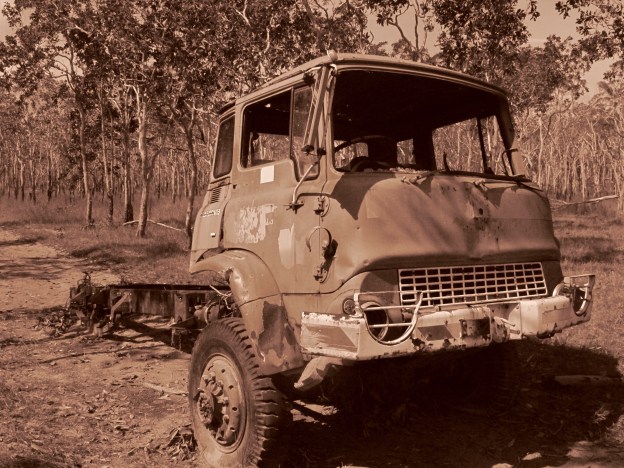
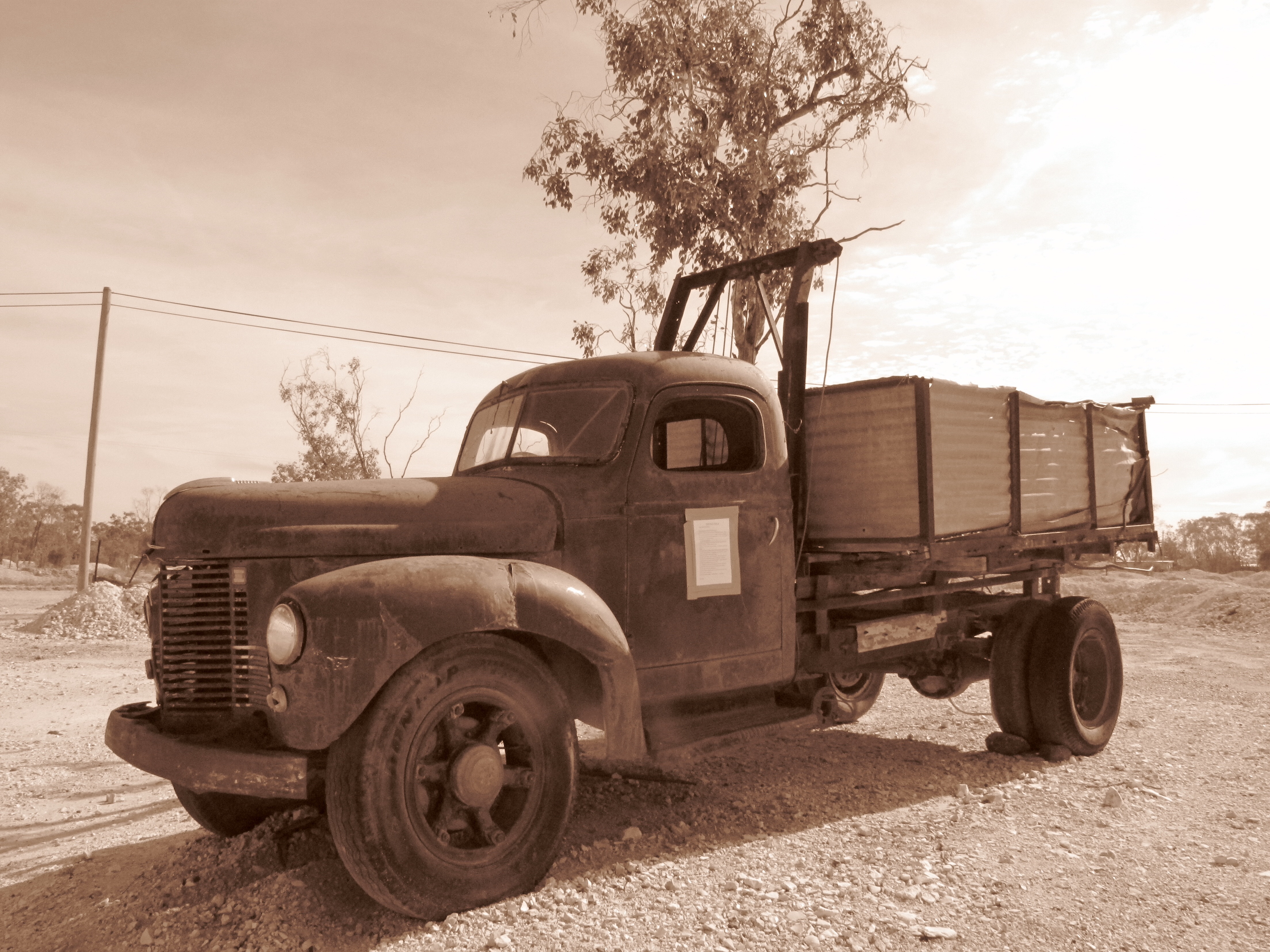
Olive tells us tales of the old Kalpower homestead that is nearby.   It must be deep in the bush now, because our search is in vain.  There are no signs of habitation except an old Bedford truck that gave up the ghost many years ago.

Further down the road,a muddy four wheel drive approaches us, containing two young men.   Don’t bother trying to get to Bathurst Heads, they say.  They have been bogged down in a mud hole for three days and have had to winch themselves out.  The road is impassable.

We make do with a campsite just off the road, towards the river.  It’s a rough, scrubby spot.  Max heads off to the river to fish.   We make camp and get a fire started.

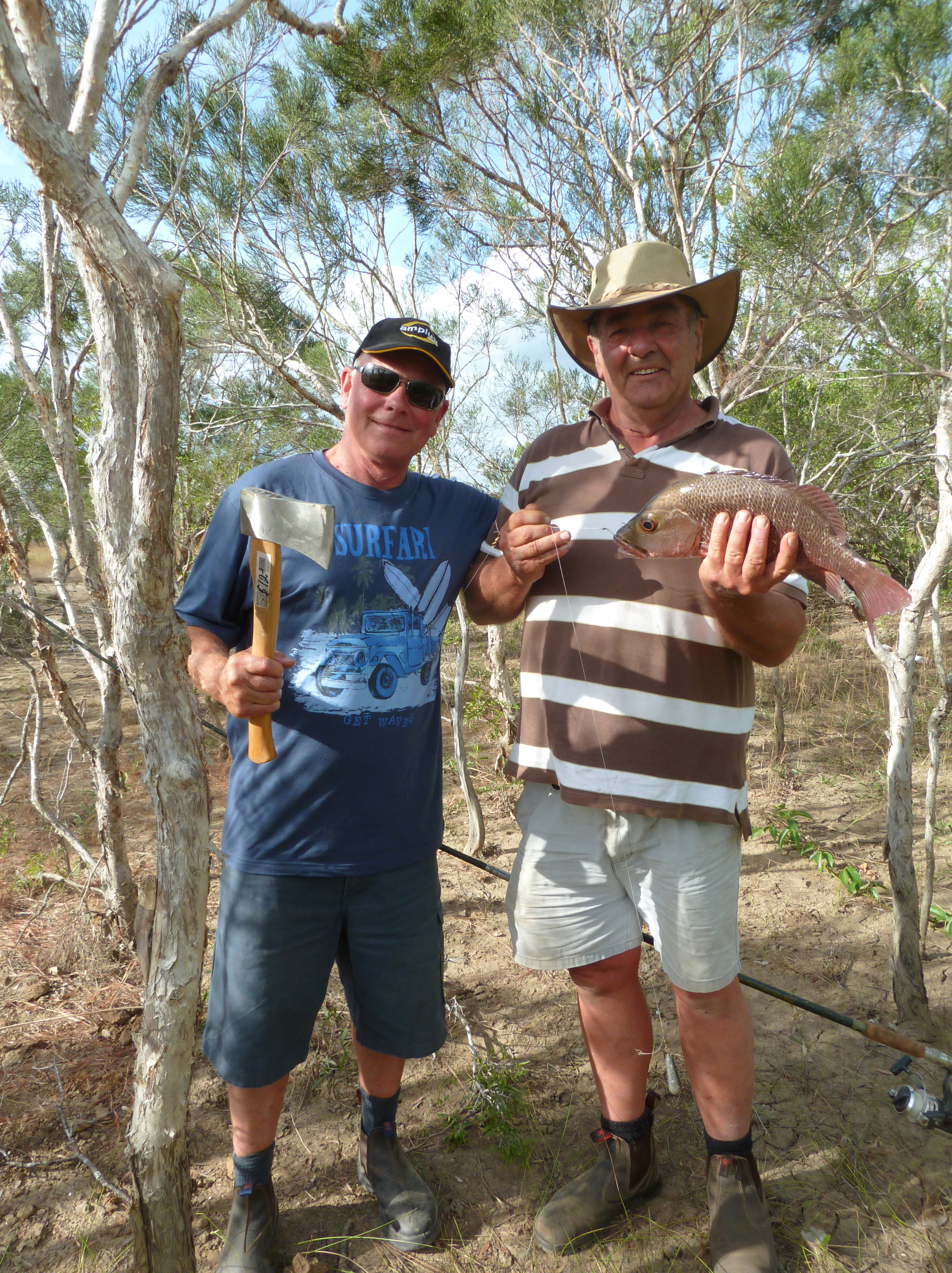
Richard, Dom and Beryl head down to the river to see how the fishing is going.  Richard, axe in hand, ready to fight off any crocodiles who may make their home here.  This morning we heard a crocodile story from the owner of the campsite.  A man was fishing in the river near the campsite and was grabbed by a four metre crocodile.  They had never seen one in that area before.  Male crocodiles have to find their own territory and move out into new areas as the population increases.

Rich and Max and axe

Luckily, the axe is not needed.   Max catches a lovely Mangrove Jack and a Bream, and Dom another Mangrove Jack.  The fish are cooked on the campfire for dinner.   The delicate taste of the fresh fish is better than any haute cuisine.

The mosquitoes are vicious.  Long trousers and sleeved shirts are essential.   They force an early retirement to our beds, after a fine ginger beer scone dessert, cooked for Richard’s birthday by chef Howard.

Roma cattle sales

The markets at Roma are on a huge scale. About a million cattle pass through the sale yards and spelling pens each year. Today more than 8000 cattle will be sold.

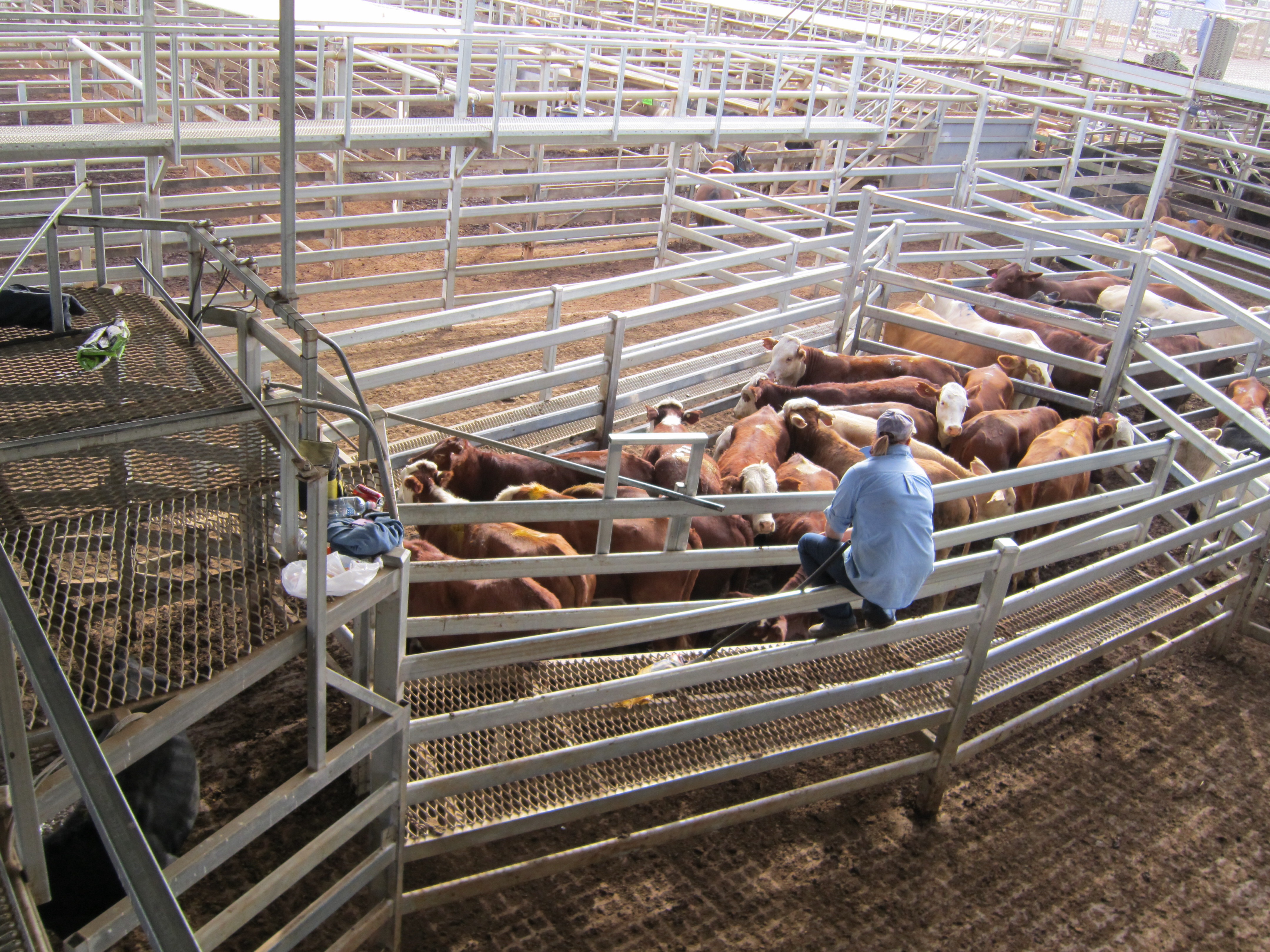
I walk along the metal gantry above the yards where the cattle are penned. Angular steel pens stretch out into the distance. The smell of manure is sharp and sour. The calls of the cattle blare out. Their mix of tone and pitch like a ragged brass band tuning up before a gig.

Brahman

The animals are grouped together into lots for sale. I watch with interest a group of Brahmans, milky white with flop ears and hump. An unusual sight in Victoria, they are common in Queensland. A group of Herefords sniff through the rails at the unfamiliar cattle next door. A solitary Droughtmaster bull stands and stares. Most of the animals are remarkably calm, despite their strange surroundings.Roma hand sits it outl

The proceedings are carefully orchestrated for speed and efficiency.

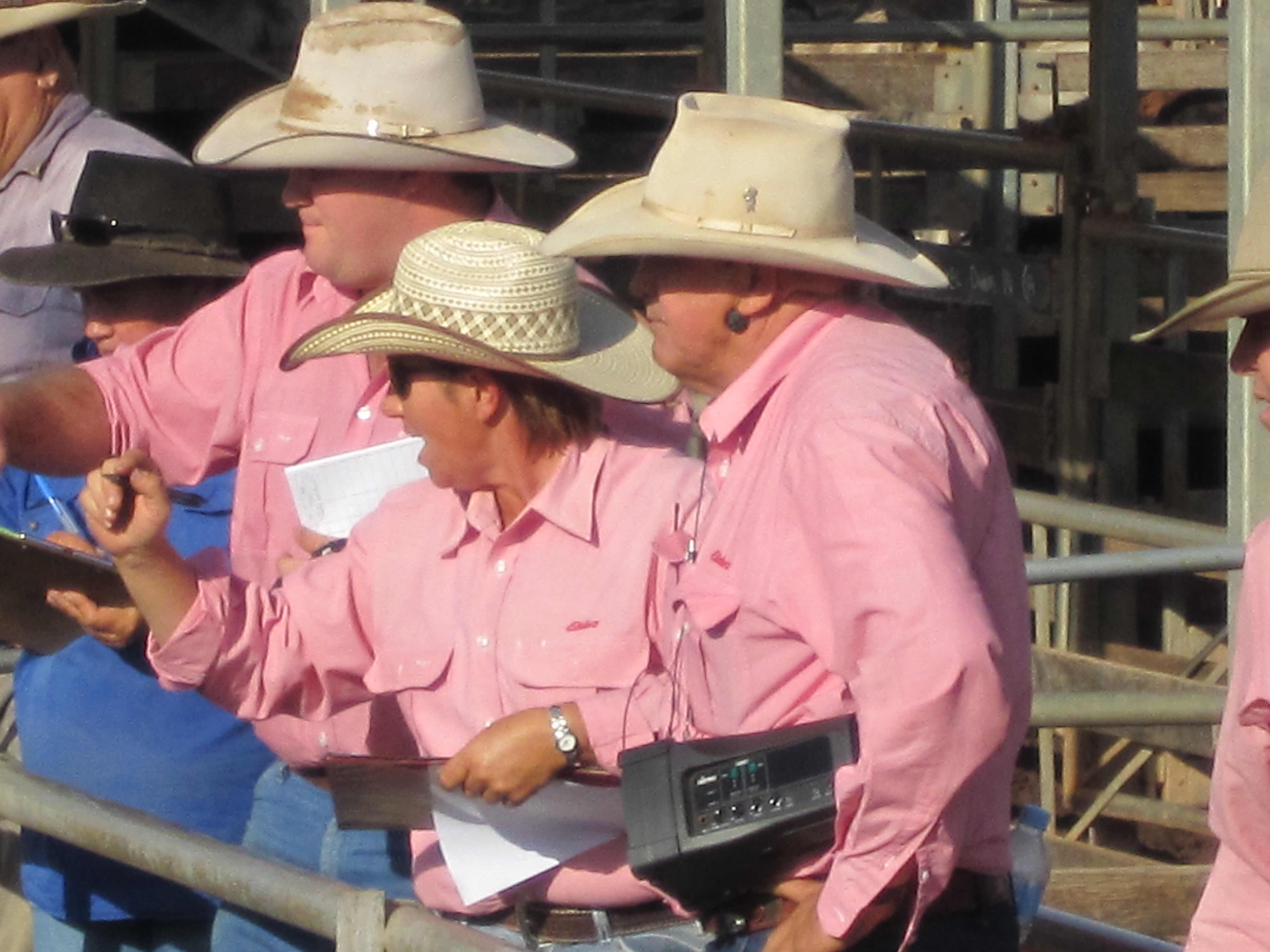
Sale yard officials are colour coded. Pink shirts are auctioneers. Spot them and you know where the action is. They jabber and gesture in an arcane ritual as unintelligible to the uninitiated as a witch doctor’s chant. As they move through the yards, a team of four, they conduct the movements in this agricultural dance.

Roma auctioneer

Blue shirts are yard hands, both men and women, driving the animals through the yards by waving old grain sacks on poly pipes. They stand on the overhead gantries above the cattle, waiting for the metal gates to open by remote control like lock gates letting the flow of animals through the system.

Roma yard

Buyers wear a mix of pastel coloured shirts, some checked some plain. They gather at ground level, moving from pen to pen to assess the quality of the stock for sale. An almost imperceptible nod or wink can buy a pen of thirty steers. To the untrained eye the buyers’ faces look impassive, their movements slow and cautious. A counterpoint to the frenzied pink shirted auctioneers.

Everyone wears a white akubra hat.

Snatches of conversation. “It’s been a patchy season.” “Good price for cows.” “Export market’s holding up.” “Prices are booming in the U.S.”

A yard hand named Fish stands and chats as we watch the sea of cattle move below us.

He’s worked at the sale yards for 35 years, starting when he was fifteen. They talked about selling them off a few years ago and there was an outcry, he says. They stay in the Shire’s hands, for now.

image

Its hard work but he loves it. Every market day the auctions run from 8am until 8pm. There are private sales using the yards and a significant business spelling cattle in the yards. There is always work to do and he knows the ways of the sale yards well. It’s a good life.

All roads lead to Roma

General Howard leads his troops out of the bush.  He’s smiling, “We’re four minutes early.”

We are on our way to Roma, home of the largest cattle sales in Australia.   The roadsides here are dotted with white fluffy cotton buds.  Cotton is cropped in the area and seedlings are breaking out of the paddocks to mix with grasses, gums and prickly pears.  A flock of bright lime green and red parrots swoops around us as the utes roll on.  Bright yellow sunflowers, more escapees from horticulture, nod as we go by. It’s a fine day in colourful Queensland.  Layers are stripped off as we moult our winter woollies.  Some go straight to shorts and tshirts while the more cautious start with slightly shorter 3/4 pants.

I blink and wipe my eyes.  No, it can’t be, that looks like a flock of bright yellow sheep.  Sure enough, here are more newly shorn sheep, happily grazing, oblivious of their lurid hue.  Yellow dyes have been added to their dip to mark out those who have been protected from ticks, lice and other parasites.  Any that have missed the dip can be easily spotted by the farmer. It’s logical, but it gives the view a surreal flavour as if we are waking from a morphine dream.

We are soon at St George and ready for morning cuppas.  St George is a gracious patrician town, wide roads, well maintained buildings, a John Deere franchise and a river frontage.   We can’t stop long to discover more this time.  It’s on to Roma and the cattle sales.

Even the scrub looks like parkland here.  Red red earth, grey green grassland dotted with trees.   Well nourished cattle wander in the shade.  We hope for a sighting of Major Mitchell’s cockatoo, a pink and yellow bird with a magnificent crest, named for Major Mitchell who explored this area in 1846.  In pictures he looks a rare beauty, (the bird, not the major) but he has not shown himself to us yet.

Lunch is at Surat.   An historic town on the Balonne river.   Bottle trees line the street, one appears to look back at us, the shape of an eye drawn in the markings in its bark.

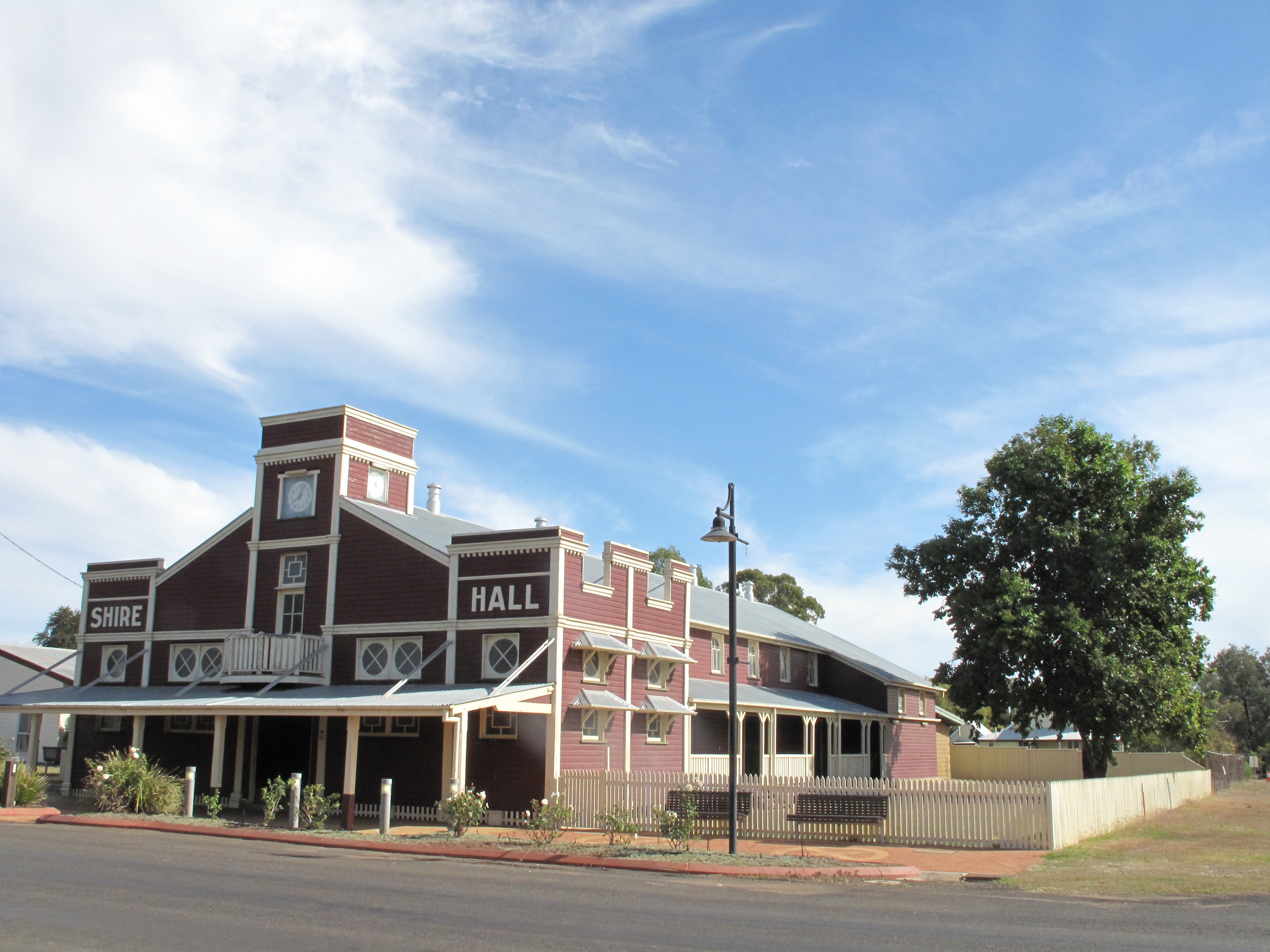
Eye in treeSurat shire hall

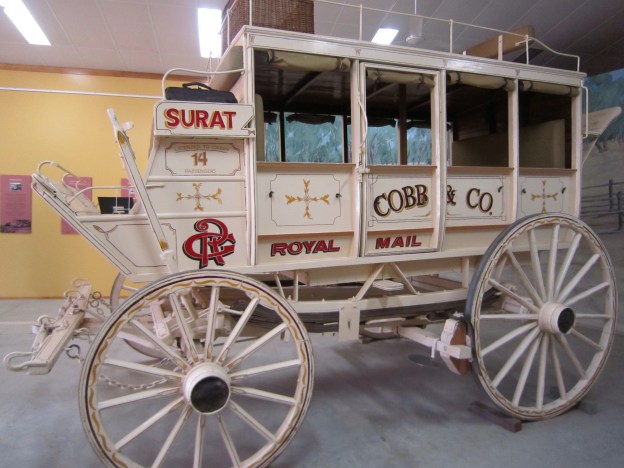
We admire the old timber buildings in Queenslander style, a post office, the magnificent old shire hall and a Cobb & Co changing station.  Inside a free museum on the Main Street there are old wool industry artefacts and the star of the show, a restored Cobb & Co carriage.

What must it have been like to speed down these roads in this wooden carriage, harnessing the power of seven horses, bouncing on the leather springs? No glass in the windows, no air conditioning to block out the climate, dust and scents of the outback.

These days it’s diesel-powered cattle trucks and road trains that drive through Surat’s Main Street.

We drive on. It’s not far from Surat to Roma. We soon see the signs for the cattle market and pull in to the sale yard car park.

Lightning Ridge

Lightning Ridge presents a more sanitised version of opal mining than we were shown in Bernie’s opal fields tour. The scent and taste of chalk dust remains.  There are just as many old Bedford trucks rusting the last days of their lives away here.  But in this town, the experience has been packaged for us.  We are guided by a map, with old car doors marking the way to the main tourist attractions.  Each “car door tour” is coloured.  The yellow tour marked with car doors painted yellow, and so on.   The tours take the sightseer around the town to take in all Lightning Ridge has to offer, and to spend some tourist dollars.

Lightning Ridge Truck

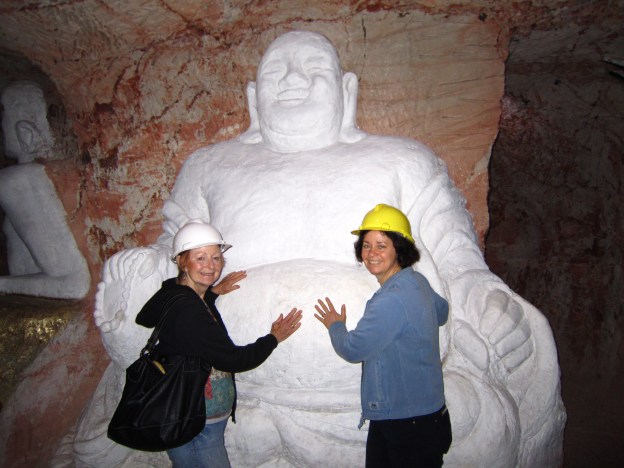
Those of us who had not visited before choose to visit the Chambers of the Black Hand.   A colourful name for an old worked opal mine that has been turned into an underground sculpture gallery.   Hard hats on, we descend into the depths.   Around the first corner we see indigenous animals carved into the wall.  Around the second we see Atlas holding the world on his shoulders.  Every section of the walls has been carved.  It’s an eclectic mix. Jesus and his twelve apostles sit at the Last Supper opposite a giant Buddha.   Ghandi is here and so are The Beatles.

Richard and Atlas Fab Four

The artist, an ex opal miner, has indulged his love of art and used it to make more money from his old opal mine than he ever made out of the opals he found there.   All cultures are represented, from Egyptian mummies to Spider-Man.  It is a remarkable feat and the gallery is fascinating to tour around.

The lower level of the mine has been kept as it was when he was still looking for opals.   We walk down into the depths to learn more about how the opal miner works the rock.  We peer into dark tunnels held up by tree trunks and listen to stories of the opal that was almost lost and of course the mythical opal millionaire.

Although my forefathers were Cornish tin miners, I feel a little claustrophobic as we wander further into the catacombs.   There is no doubt that the opal is a beautiful stone with colours from across the spectrum, but I make no purchase at the little shop at the end of our tour.   Heather spots some dainty earrings and after some expert haggling comes away with an excellent bargain.  Everyone is happy.

After Lightning Ridge we drive further north and across the border into Queensland.  Almost immediately it feels warmer.   “You can stop travelling now, you’re here”, says the shopkeeper at Hebel.  She’s a Queensland patriot.

This country is in drought.  We learn that there has been no real rain in four years.  10 mm in the last few days barely wets the dust and is not enough to break a drought.   Local industries are feeling the strain, and all they can do is eke out an existence until it rains.  Farmers have to choose between buying in feed for their stock or selling now and building up again when the rains come.  Some will go to the wall.

It is hard to predict drought.  Rainfall is a capricious creature.  It will drop more than 100mm in one area while leaving neighbouring towns bone dry.   While some parts of Queensland are flooded by typhoons, others wither away.   It takes a certain rugged resilience to hold out for four years without rain, ever hopeful that this month will be different.  This month the break will come.

It has not come yet for Hebel.

Opal fields

The Bourke bakery’s range of apple cream cakes, pies and turnovers is impressive.   It’s too much of a temptation not to buy a few for morning tea.  A trip to the historic Bourke port and we’ll be off.

This was once the largest inland port in the world, shipping wool on the Darling River.  Little remains, but a timber wharf that stands high above the current river flow.   People of Bourke’s great days would not have believed that the busy port could become almost a backwater.   In the 21st century, river transport has all but ended and the timber structures that were once a hive of industry support only the feet of curious tourists and day trippers.

Leaving the old port, we drive alongside the Barwon River and stop at Brewarinna for morning tea and Bourke’s apple cream cakes.   This Barwon is not our familiar Victorian river, but a longer water course, extending 700 km through New South Wales.   Here at Brewarinna it contains aboriginal stone fish traps that are reported to be more than 30 thousand years old, perhaps the oldest man made structure in the world.   The fish traps were so successful the town was an important aboriginal meeting place in times gone by.

Turning away from the Barwon River, we head to Walgett and then to Lightning Ridge.  We are in opal country.   Olive has heard of an interesting little mining town off the main track, and we take a detour through cypress pine plantations to the tiny town of Cumborah.  It is littered with fascinating old trucks, cars and houses, most of them for sale.

Olive

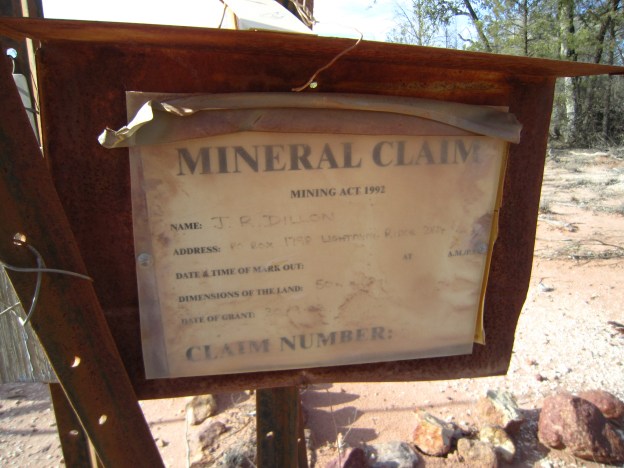
Soon after the town, we take a turn off the road and on to a dirt track, signposted “opal fields”.  Little do we know, but we are about to enter another world.   Opal miners live here.  They lease small parcels of land from the Department of Mines for exploration and excavation.  They are seeking the black opal and their fortunes.

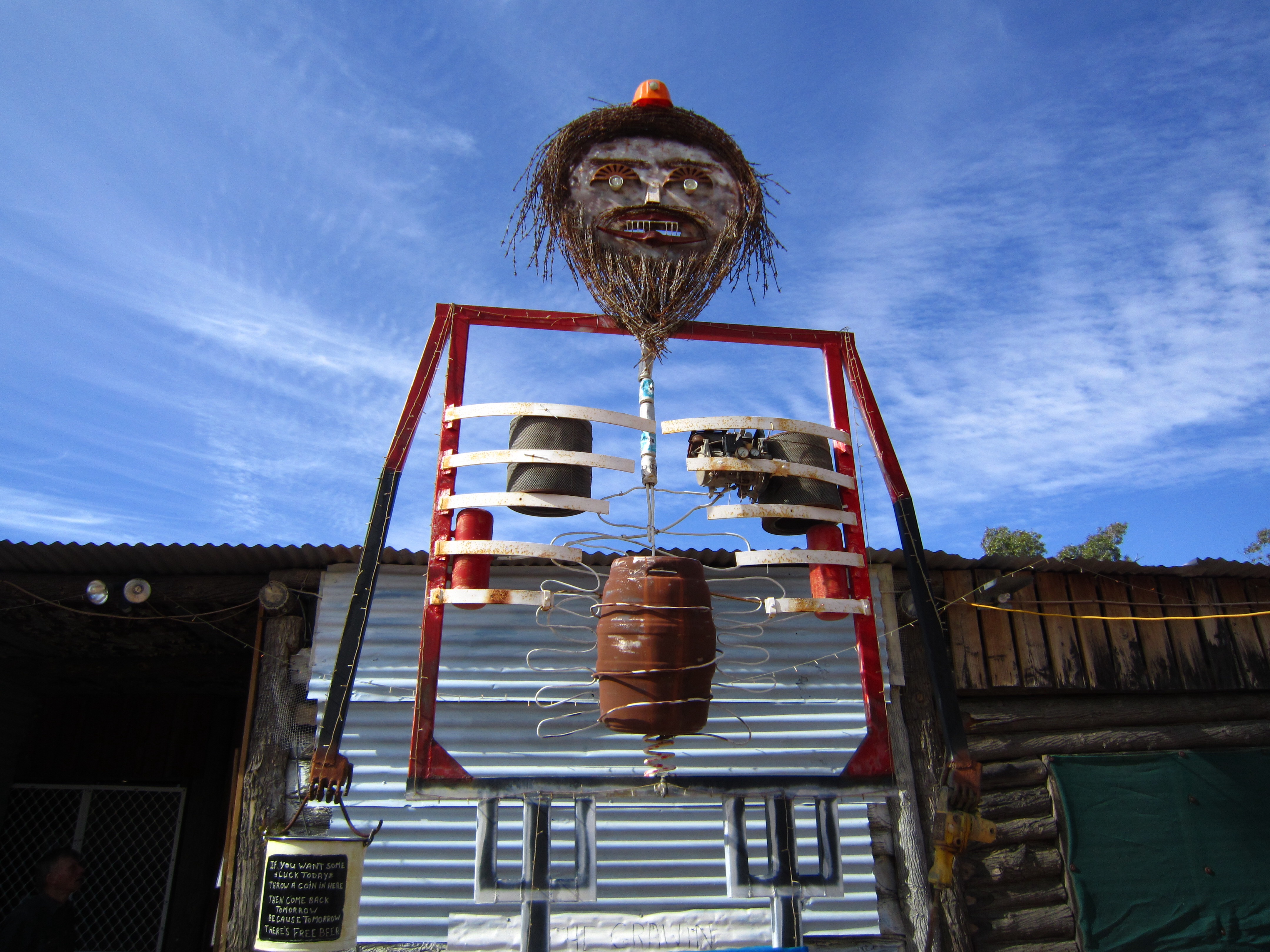
It is a world apart.   Our first stop is the Grawin “Club in the Scrub”.  A golf club, but not like any we have seen before.   Rocky fairways lead to red sandy greens.  The club house is timber and tin.   The club members are like extras from Mad Max – but on their day off, enjoying a social drink and a chook raffle with friends.

Club in scrub

Howard, Beryl and Suzanne strike up a conversation with a friendly type in the car park.   We are soon off on an ad hoc tour of the mines and the local community.   Bernie, our new friend and guide, leads us into a maze of narrow rocky roads.

Opal fields road

This is a world away from mainstream Australian life.   Old machinery comes here to die.   Beneath the ground, the area is honeycombed with old mine workings as miners follow the opal seams looking for their fortunes.

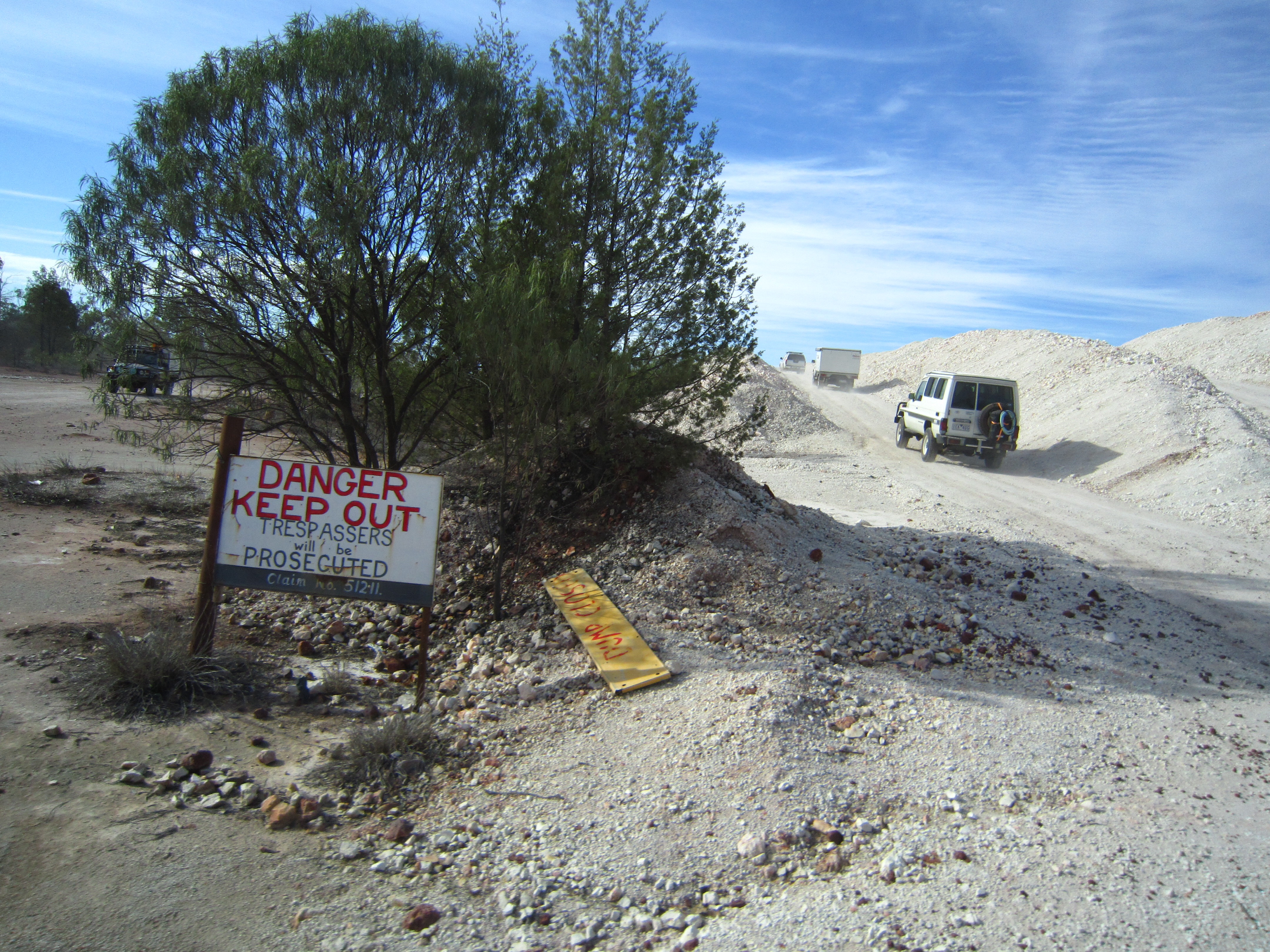
The chalky white rock dug up from underground mine excavation litters the landscape.   The world turns white and dusty.  A moonscape marked by quirky handmade signposts.  “Cars with brakes give way”.

We drive between tin shacks and old machinery.  If there are millionaires here, they are disguised well.  This is a handmade, manmade world without the restrictions of suburban life.   It feels post-apocalyptic.   Forget modern technology, here it is man, rock and the diesel engine.  If they can repair, make do or recycle they will.

image

Bernie proudly takes us home to show us his prize opal, worth 100 or at least 50 thousand dollars.  Cut and set in a gold pendant for his wife, his eyes twinkle when he opens the velvet covered box to display it.   “She loves it, but you can have it for fifty, I need to upgrade the rig”.  He’s got the bug.  Introduced to opal mining by his father at fifteen, he’s itching to dig into a new lease and who knows, maybe find the seam that will add his name to the list of opal millionaires.

We feel honoured to be taken into his confidence and his home.   It’s a relief nonetheless to emerge from that chalky underworld and make our way to set up for the night at Lightning Ridge.

Thanks Bernie, I hope you find the big one, you deserve it.


Road closed

We wake to the mournful cawing of a crow. It feels good to be in the bush again.

Dom has been tending the fire in the night and the embers are hot and glowing. The campfire is welcome in the cool air and we warm ourselves around it.  The toasting fork comes out and we enjoy buttered toast for breakfast.

We’ve heard rumour there’s been a heavy fall of rain in the area and some of the roads may be closed. Driving towards Wilcannia I imagine rain on this road. It’s little more than a deep rut cut into the red earth. Water would run through here like a river.

Sweet little kids follow attentive nanny goats into the bush as we pass. A big old roo reclining in the sun lifts his head to watch. The road becomes more rutted As we drive on. There’s a road sign on an unsealed side road to Bourke. Taking a quick detour to check the sign posted nearby, we see it says “Road Closed”. This is not promising.

Our plan today is to tour along the Darling through Tilpa, and on to Bourke along the river route. When we reach Wilcannia, we find there has been 70 mm of rain and the roads have been closed. There’s a heavy fine for using a closed road, $1000 a wheel, we are told. Add to that the risk of getting bogged, and of damaging the road for other users. There’s no option, we have to change our plans and drive to Cobar and take the Barrier Highway to Bourke.

Back on the bitumen. The highway is busy with traffic. Grey nomads in caravans jostle with huge trucks. It’s not what we were hoping to see today. But the highway does not disturb the wildlife.   Indigenous kangaroos are outnumbered by the imported goats. We see hundreds of them, all well fed, healthy and leading kids.

A B Double truck drives up the tail of our convoy, urging us to move faster. Caravanners slow ahead of us. We are caught between them. Malcolm engages the truck driver on the radio. Howard in the lead calls out when the road is clear and we overtake the caravans one by one.

At lunch we are accosted by cheeky apostle birds hopping on to the picnic table at the truck stop and swooping on crumbs. The birds are so named because they live in family groups of twelve, like the twelve biblical apostles.

It’s a long tiring journey to Bourke, but finally we arrive. The caravan park, Kidman Camp, is way out at the back of Bourke. It is worth the trip. Showers, kitchen, laundry and a lovely quiet camping spot.

A bus to the local bowling club picks us up for dinner. It’s Chinese food with Tracy and Caitlin. A tower of brightly coloured balloons perches on a half empty table of local girls. They are here to celebrate the 18th birthday of a fragile looking girl with pale skin and long blonde hair. We raise our voices to join the room singing happy birthday, and wish her well.

The bus back to camp takes a circuitous route through the suburbs of Bourke to drop off the locals after a night of pokies at the bowling club. It’s hard to get a feeling for the town we are in, having seen so little of it. I think I will reserve judgement on Bourke until I can spend more time here.

The Long Paddock

The flat, featureless saltbush plains stretch into the haze on the horizon. We are driving the Cobb Highway, the Long Paddock. Since the 1840s drovers have been driving cattle along this track, from stations in Queensland to the markets in Victoria.

The vegetation offers little relief to the traveller’s eye. The drought tolerant, mineral rich saltbush puts on no airs and graces. It’s not an ostentatious plant. It hides its value beneath its dull grey-green scrubby appearance. Plain but highly nutritious, sheep grow fat and healthy on it. It dominates these plains.

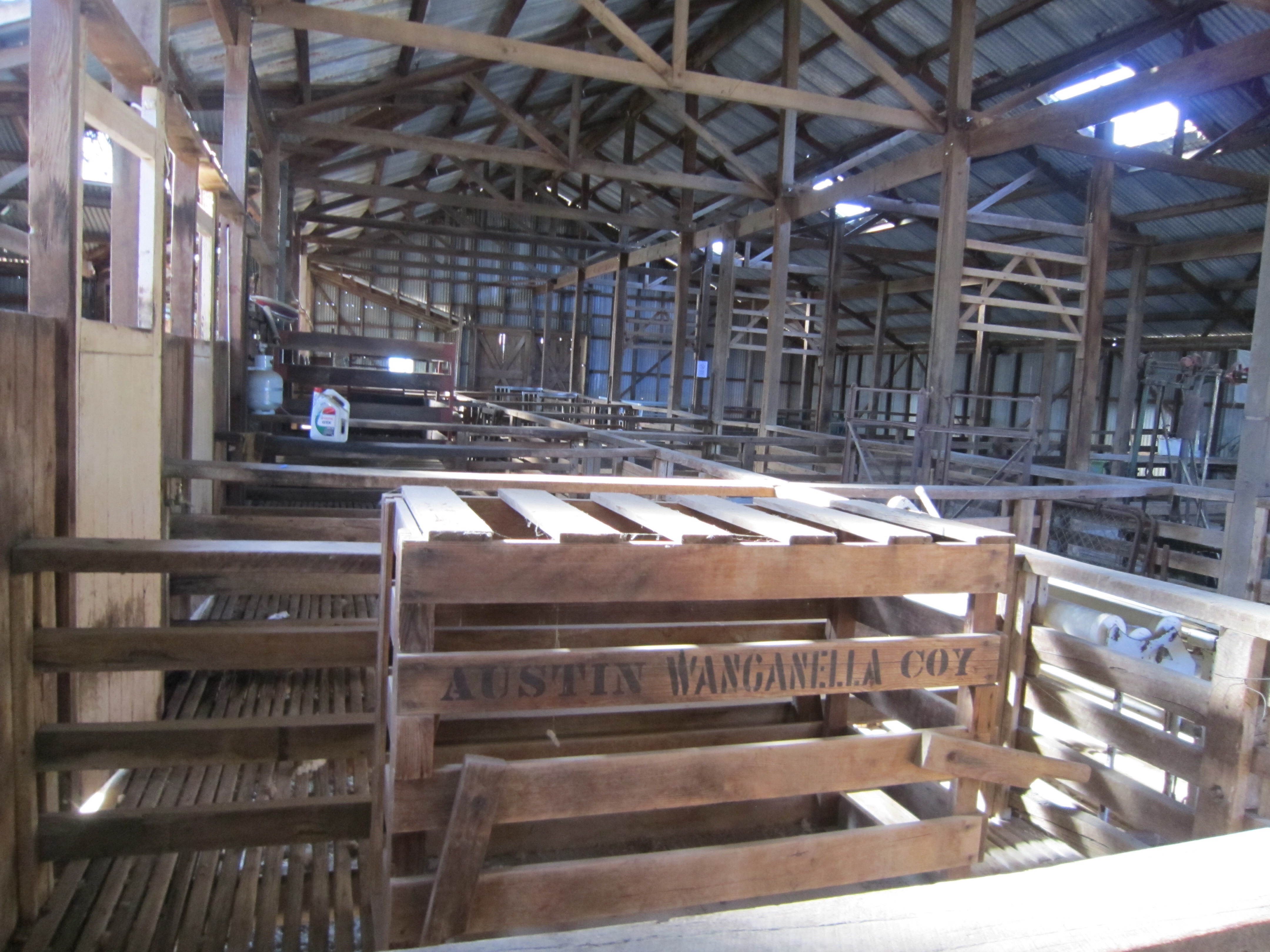
At Hay we stop to visit the historic timber woolshed, moved stick by stick from Darling Downs to become a tourist attraction and home to the shearers’ hall of fame.

The wool industry has had mixed fortunes in Australia of late. Animal rights activists condemn the practice of mulesing as barbaric and cruel. The wool industry claims it is essential, extending the life of sheep many years by preventing them from becoming flyblown.

The debate is heated and insults are thrown both ways.

While the romance of the shearing shed loses its appeal at home, overseas markets, especially China and Russia, are increasing demand for wool and prices are buoyant

Billy, the demonstration shearer at Hay, is defensive. He is part of the marketing arm of a major industry and defender of a romantic bush ideal. Highly skilled, he shears a lamb in minutes. His strong arms are in control, the young animal relaxes and calmly accepts his actions.

image

The worn timbers of the woolshed, the scent of lanolin and the raw earthy animal smell of the sheep, evoke another world. I fear for sheep that may in the future be shorn by robots in a factory to six sigma efficiency. I hope Billy and others like him continue their craft. Rough and basic this life might be, but these men work closely with the sheep and lambs, they know them, understand their ways. Let’s hold that relationship dear, for all its faults. Let’s cherish the good in that and build on it.

As Hay disappears in the rear view mirror, emus scatter alongside the road, their tail feathers bouncing like ladies bustles behind them. Driving north, the sun is high and reflects on the bonnet of the car, raising the temperature. Soon we long for cuppas and ice cream, and make a stop at the small town of Ivanhoe.

While Richard checks out the list of road closures and the Connoisseur ice cream, I admire the art works displayed in the shop windows along the Main Street. An initiative at the local correctional centre has created remarkable line drawings of bush characters. Each drawing was created on grid fashion with each artist assigned a square of the grid. A clever teaching method that produced great results.

image

The saltbush plains are behind us now, the roads are iron red sand, unpassable in the wet. A frosting of green pick contrasts with the red dirt to create vivid colour combinations. The country is alive with emus, goats, sheep and kangaroos, all feeding from the minerals held in the rich red soil. The pale wintry colours of Victoria are forgotten as we speed onwards.

As the afternoon draws on we begin to look for our first bush camp of the trip. Howard does it again. “We’re stopping here”, crackles the radio as the utes turn off to the right. 500 m off the road, we pull into a beautiful treed clearing, partly protected from the wind by mounding sand. There’s plenty of wood for the campfire and soon we are cooking dinner together, enjoying the warmth of the fire and the conversation. As I retire to bed, I hear a male voice raised in song, a beautiful Italian operatic aria rings out across the sands, combining with the faint song of nature as the wind whistles and moans in the casuarinas.